
Tag: Green Aviation

Optimization, New Designs and Alternative Fuels Make Aviation Greener

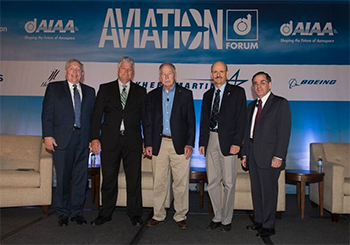
Panelists: Moderator John Tylko, chief innovation officer, Aurora Flight Sciences; Fay Collier, project manager, Environmentally Responsible Aviation, NASA’s Langley Research Center; Mark Drela, Terry J. Kohler professor, Department of Aeronautics and Astronautics, Massachusetts Institute of Technology; Alan H. Epstein, vice president of technology and environment, Pratt & Whitney; Robert H. Liebeck, chief scientist of the blended wing body airplane program, Boeing Defense, Space & Security

by Hannah Godofsky, AIAA Communications
Perspectives-and-Progress-on-Green-Aviation-AVIATION2017
Participants in the panel discussion, “Perspectives and Progress on Green Aviation,” June 5 during the 2017 AIAA AVIATION Forum in Denver.

Flight has already become much more efficient over the past 60 years, but with further optimization as well as the implementation of new designs and new fuels, an even greener future is possible, according to members of the “Perspectives and Progress on Green Aviation” panel June 5 at the 2017 AIAA AVIATION Forum in Denver.

“The industry curve is largely flattened at roughly a 1.5 percent annual improvement, and no surprise the aircraft silhouette has remained largely the same since the introduction of the 707,” John Tylko, chief innovation officer at Aurora Flight Sciences, said of the status quo in fuel efficiency and green aviation.

Fay Collier, project manager of Environmentally Responsible Aviation with NASA’s Langley Research Center, said NASA has set bigger goals for reducing emissions and aircraft noise. He said NASA’s N+2 and N+3 goals aim to create new airframe and engine integration concepts to reduce noise and fuel burn.

One such example is the X-48B demonstrator. Robert Liebeck, chief scientist with the blended wing body airplane program at Boeing, said researchers at NASA’s Armstrong Flight Research Center have performed 122 test flights to date of the blended wing body aircraft.

“The airplane is robust and flies very well,” said Liebeck, showing a diagram of the structure of an X-48, which looks more like a cross-section of a submarine. “Structure … was the big challenge. You have bending loads in both directions, and then you’ve got a pressure load.”

Mark Drela, a professor at the Massachusetts Institute of Technology, spoke about design and optimization.

“Any time you have a new technology, there’s a very good chance — in fact, it’s almost certain — that the best use of that technology will be somewhere away from the current design practice,” Drela said. “We think it’s really important to re-optimize the entire system — and by system, I mean the airframe, the engine and the operation parameters — simultaneously so that you fully realize that potential of the new technology.”

Even if each optimization increases fuel efficiency by only 1 or 2 percent, he said, that could really add up across 20 different optimizable features.

Alan Epstein, vice president of technology and environment at Pratt & Whitney, explained that the propulsion system is currently about 20 percent of the value of a new airplane with today’s designs and that increasing that cost means gains in efficiency have to be substantial enough for airlines to be able to justify investment in a new system.

“At the current cost of fuel, the hybrid-electric airplane has to be 42 percent better in fuel burn to be cost neutral,” he said.

That’s a tough goal to meet, Epstein explained, adding that the math for new, more efficient aircraft does look better if fuel prices are higher.

“So how do we really go green?” he asked. “We go with sustainable alternative jet fuels. There’s hundreds of millions of gallons on order. If you fly out of LAX, now you’ll fly partially on sustainable alternative fuels.”

Videos

Part 1

Part 2

All 2017 AIAA AVIATION Forum Videos

Dryden Lecturer Addresses Future of Getting to Greener Aviation

By Anne Wainscott-Sargent, AIAA Communications Team

As the aviation sector looks to achieve net zero carbon emissions by 2050, the biggest gains may not happen in the air but on the ground, stated Tim Lieuwen, the 2025 AIAA Dryden Lecturer in Research, during the 2025 AIAA SciTech Forum in January.

Watch Full Session On Demand 

“The least cost way to get to a net-zero society is to take a system view about economy-wide CO2 emissions and where and how aviation fits into that, rather than trying to zero out CO2 emissions sector by sector.  It makes sense if you think about it – it’s a whole lot cheaper to manage your CO2 emissions from something that’s sitting on the ground, potentially sitting right above a depleted oil reservoir versus trying to manage something that’s flying around and has to deal with all the safety issues of aviation,” said Lieuwen.

The Georgia Tech executive vice president for Research, Regents’ Professor, holder of the David S. Lewis, Jr. Chair, and the executive director of the Strategic Energy Institute  explored the interconnectedness of energy sources, carriers, and storage systems, noting the significant role of fossil fuels in the current U.S. energy system and the potential for synthetic fuels.

He highlighted four different options for zeroing out climate impacts using a high-fidelity model of the entire energy system. Organized in a 2×2 matrix, the model showed the option of economy-wide decarbonization, where different sectors contribute in a coordinated way. Then he presented a visual of sector-by-sector decarbonization, where each sector individually zeroes out its contributions.

According to the EPA, transportation is the largest contributor of CO2 emissions, with the aviation sector contributing roughly 2.5%, compared with 28% from automobiles.

Lieuwen noted there is a difference between zero CO2 and net zero. Net zero focuses on the overall CO2 emissions budget, allowing for some sectors to potentially emit CO2 and some sectors to be net-negative CO2.  In this scenario, the least-cost role of aviation in an economy wide net-zero CO2 society is a mix of conventional fossil fuels and renewable hydrocarbons like sustainable aviation fuels (SAF). If aviation’s aim is to pursue “a least-cost societal net-zero target,” then he advocated for an economy-wide net zero strategy.

Using a least-cost model, the energy expert showed some surprising insights where fossil fuels and renewable fuels are equally split 50/50.

“Half are fossil fuels and the other half are synthetic fuels that you can manufacture like SAF. You see big growth in renewables and big growth in biofuels,” he explained.

Lieuwen also observed that in this least-cost world, half of all energy will rely on electricity which will prompt big growth in electrification, going from 20% to 50%. He also predicted significant R&D investments around power electronics, high-voltage motors, batteries, and energy storage.

Fossil Fuels Dominate Current Energy Economy
Another big takeaway was how society moves and stores energy will continue to use  fossil fuels, although in a significantly diminished role from today.

“We’re in an 80/20 split with the current U.S. energy economy as a whole, which means that we use fossil fuels roughly for 80% of the means by which we move energy around and store it. We use electricity as an energy carrier for the other 20%. These are multi-trillion-dollar sectors. It’s important to recognize the interconnectedness of all this. For example, the aviation sector is leveraging and contributing technologically to and is also benefiting from infrastructure of existing industrial sectors, such as oil pipelines and the oil refining industry.”

Aviation’s Critical Role
Part of achieving this least-cost societal net-zero target in aviation is developing SAF, which currently are more expensive than fossil fuel, and will likely require policy levers, carbon taxes, or tax credits to become a reality, Lieuwen predicted.

There will continue to be a premium placed on aviation advances that offer thermal efficiency as well as operational flexibility.

“The ability to have systems that are low emission/high efficiency, but yet don’t surge/don’t stall, where your flame stays attached, where the system is stable, is very, very important,” said the researcher before briefly sharing highlights of his research that focuses on better understanding the interaction of how fast waves of flames move in combustion engines.

“The interaction of acoustic waves… create interference patterns which are controlled by how fast vortices move versus how fast waves on flames move,” he explained. “If a vortex is not moving at the same speed, what’s happening is you have two periodical disturbances moving at different velocities.”

This phenomenon leads to destructive instabilities in rockets, in home heaters, and in aircraft engines, Lieuwen shared.

Asked after his presentation if he thought the increased tempo in rocket launches would hurt efforts to decarbonize, Lieuwen said, “I would suspect the overall carbon footprint that is going to those direct launches will pale relative to other sectors.” He predicted major follow-on secondary impacts from all the satellite activity, however.

Nuclear’s Potential
Another question concerned the role of nuclear energy in getting to net zero. “Nuclear is really important,” said Lieuwen. “In fact, if we could solve this problem of low-cost nuclear [energy] it would totally transform what least-cost net zero looks like.”

Amanda Simpson, former deputy assistant Secretary for Energy under the Obama administration who also directed the U.S. Army Office of Energy Initiatives, found Lieuwen’s remarks timely and on target. The former VP for Research and Technology and head of Sustainability for Airbus Americas said that the aviation sector has grappled with the question of whether net zero by 2050 is the right commitment.

“While it’s an admirable goal, is it a realistic? It’s a very expensive and difficult goal,” she said.
Simpson added that addressing the CO2 issue in aviation is also hard, and she agreed with Lieuwen that it’s easier to decarbonize something on the ground.

“There’s so much to be done in the remaining 26 years, we have to go after everything. There is not going to be a silver bullet – we have to tackle everything to start bringing the [greenhouse gas usage] totals back,” she said.

 On Demand Recording Available

Watch Full Session On Demand