
Fluid-Filled Porous Composites: Multifunctional Design for Space Applications (1-Day Course at SciTech Forum 2027) 10 January 2027 - 10 January 2027 Hyatt Regency Orlando 1 Full-day (8 a.m.–5 p.m., 8 hours)
- Full-Day Course, held in conjunction with the AIAA SciTech Forum 2027 in Orlando, Florida
- Sunday, 10 January 2027, at the Hyatt Regency Orlando
- All students will receive an AIAA Certificate of Completion at the end of the course
- This course represents the first comprehensive educational offering on fluid-filled cellular composites, synthesizing two decades of research from biological inspiration through NASA validation. This full-day course will include:
- Deep dive into theoretical foundations and practical applications
- Hands-on learning with physical samples and computational tools
- Interactive design exercises building participant competency
- Direct access to the research team for detailed technical discussions
- Networking opportunities with leaders in biomimetic materials
OVERVIEW
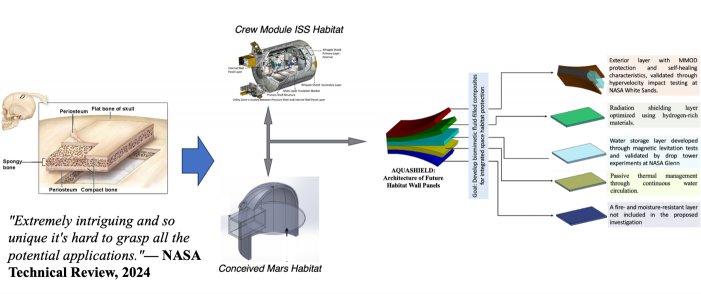
Inspired by the fluid-filled architecture of the human skull, Fluid-Filled Porous Composites (FFPC) integrate radiation shielding, micrometeoroid protection, thermal management, and water storage into a single lightweight wall panel — replacing four separate systems with one. Validated at NASA, AFRL, Los Alamos, and Sandia over two decades, FFPC delivers 56% lower radiation dose than aluminum, 40% mass reduction, and passive thermal control within 30°F, earning a 2024 NASA Technical Review comment that the technology is “extremely intriguing and so unique it’s hard to grasp all the potential applications.” NASA’s $750,000 EPSCoR AQUASHIELD award is now advancing it from TRL 3 to TRL 6.
This full-day course – the first of its kind on FFPC – will take participants from biological foundations through 3D-printed capillary networks, multi-physics modeling, and space habitat integration, drawing directly on the AQUASHIELD research program and its team spanning NMT, UNM, NASA Glenn, NASA White Sands, AFRL, and Redwire Space.
The course is co-instructed by Dr. Ashok K. Ghosh, Ph.D., P.E., Associate Professor of Mechanical Engineering at New Mexico Institute of Mining and Technology and Science PI of the NASA EPSCoR AQUASHIELD project, and Dr. Yu-Lin Shen, Ph.D., Professor of Mechanical Engineering at the University of New Mexico, ASME Fellow, and Co-PI of the AQUASHIELD project. Together they bring over five decades of combined research experience in bio-inspired composites, computational modeling, and space materials to this course.
LEARNING OBJECTIVES
By the end of this course, participants will:
- Understand the biological foundations and design principles of FFCC
- Learn multifunctional capabilities (radiation shielding, thermal management, impact protection, and water storage)
- Gain practical knowledge of manufacturing methods using additive manufacturing
- Explore computational modeling approaches for FFCC design and analysis
- [See below for detailed course outline]
AUDIENCE
Engineers, researchers, graduate students representing in part:
ASME, ASCE, MRS (Materials Research Society), SAMPE, ASTM International (Committee D30), NASA (Glenn, Kennedy, Langley, White Sands), DoD/AFRL, Sandia and Los Alamos National Laboratories, Redwire Space, Boeing, Lockheed Martin, SpaceX, attendees of ASME IMECE, SAMPE, MRS conferences, and Mechanical/Aerospace Engineering departments at research universities nationwide.
REGISTRATION FEES (Register Here)
AIAA Member: $545 USD
Student: $295 USD
Non-Member: $645 USD
Register for the course only or as an add-on to Conference registrations. Course participation is in-person only.
———————————————————————
Schedule (8 a.m.–5 p.m., 8 hours)
Session 1: Foundations and Biological Inspiration (8–10 a.m.)
8–8:15 a.m.: Welcome and Introduction
- Course overview and objectives
- Introduction to bio-inspired materials engineering paradigm
- Presenter: Dr. Ashok Ghosh/Dr. Yu-Lin Shen
8:15–9 a.m.: Nature’s Blueprint – Biological Structures as Engineering Models
- Trabecular bone architecture and hierarchical porosity
- Human skull: multifunctional protection system
- Tree xylem and capillary transport mechanisms
- Morphometric analysis and quantitative characterization (microCT, SEM)
- Presenter: Dr. Ashok Ghosh/Dr. Yu-Lin Shen
9–9:45 a.m.: FFCC Fundamentals – Design Principles and Material Architecture
- Definition and classification of fluid-filled cellular composites
- Multifunctional design philosophy
- Structure-property relationships
- Evolution from concept to AQUASHIELD technology
- Presenter: Dr. Ashok Ghosh/Dr. Yu-Lin Shen
9:45–10 a.m.: Break
Session 2: Multifunctional Performance (10 a.m.–12 p.m.)
10–10:45 a.m.: Radiation Shielding for Space Applications
- Galactic cosmic rays and solar particle events
- Water as shielding medium: dose equivalent reduction
- AQUASHIELD architecture and performance validation
- NASA validation testing
- Presenter: Dr. Ashok Ghosh/Dr. Yu-Lin Shen
10:45–11:30 a.m.: Thermal Management and Impact Protection
- Passive thermal regulation through fluid circulation
- Phase change materials integration
- Impact energy absorption mechanisms
- Micrometeoroid and orbital debris (MMOD) protection
- Experimental validation
- Presenter: Dr. Ashok Ghosh/Dr. Yu-Lin Shen
11:30 a.m.–12 p.m.: Water Storage and Life Support Integration
- Dual-use concept: structure + consumables
- Forward osmosis integration for water purification
- Mass efficiency for long-duration space missions
- Systems-level integration with habitat architecture
- Presenter: Dr. Ashok Ghosh/Dr. Yu-Lin Shen
12–1 p.m.: Lunch Break
Session 3: Design, Manufacturing, and Modeling (1–3 p.m.)
1–1:45 p.m.: Additive Manufacturing of FFCC Structures
- 3D printing technologies for complex geometries
- Material selection: polymers, ceramics, composites
- Multi-material printing strategies
- Quality control and defect characterization
- Scalability considerations
- Presenter: Dr. Ashok Ghosh/Dr. Yu-Lin Shen
- Hands-on Component: Physical samples demonstration
1:45–3 p.m.: Computational Modeling and Simulation
- CAD translation from biological structures
- Finite element analysis and model construction
- Multi-physics considerations: structural, thermal, fluid dynamics, impact
- Optimization algorithms for FFCC design
- Verification and validation strategies
- Presenter: Dr. Ashok Ghosh/Dr. Yu-Lin Shen
- Support: Graduate Student – Software demonstration
3–3:15 p.m.: Break
Session 4: Applications, Standards, and Future Directions (3:15 p.m.–5 p.m.)
3:15–4 p.m.: Applications Across Domains
- Aerospace: Deep space habitats, lunar/Mars surface structures
- Defense: Protective armor, blast mitigation
- Energy: Thermal storage, efficient heat exchangers
- Water treatment: Desalination, produced water treatment
- Biomedical: Tissue scaffolds, controlled drug delivery
- Case studies and performance metrics
- Presenter: Dr. Ashok Ghosh/Dr. Yu-Lin Shen
4–4:50 p.m.: Research Frontiers and Open Challenges
- Self-healing FFCC systems
- Smart/adaptive fluid-filled structures
- Machine learning for design optimization
- Sustainability and recyclability considerations
- Collaboration opportunities
- Presenter: Dr. Ashok Ghosh/Dr. Yu-Lin Shen with graduate student perspectives
4:50–5 p.m.: Closing Remarks and Q&A
- Summary of key takeaways
- Distribution of resource materials and references
- Networking opportunities
- Presenter: Dr. Ashok Ghosh/Dr. Yu-Lin Shen
————————————
CONTACT
Please contact Lisa Le, Education Manager, for questions about the course or group discounts (for 5+ participants).
Soft copy course notes will be made available 3-5 days prior to the course event. You will receive an email with detailed instructions on how to access your course notes. Since these notes will not be distributed on site, AIAA and your course instructor highly recommend that you bring your computer with the course notes already downloaded.
AIAA Training Links
-
For information, group discounts,
and private course pricing, contact:
Lisa Le, Education Specialist ([email protected])