Machine Learning for Fluid Dynamics – Online Short Course 22 March 2027 - 14 April 2027 Online
- From 22 March–14 April 2027 (4 Weeks, 8 Classes, 16 Total Hours)
- Every Monday and Wednesday at 11:30 a.m.–1:30 p.m. Eastern Time (all sessions will be recorded and available for replay; course notes will be available for download)
- In this new cutting-edge course, participants will learn about Neural Operators, Physics-Informed Models, and Flow Feature Detection
- All students will receive an AIAA Certificate of Completion at the end of the course.
OVERVIEW
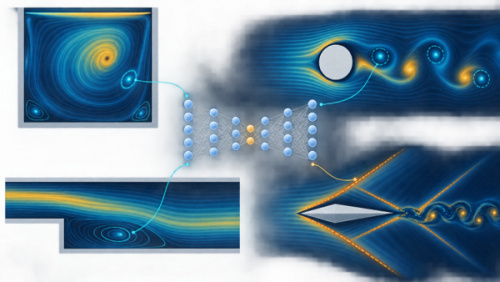
This intermediate, 16-hour short course introduces machine learning for fluid dynamics through practical examples involving lid-driven cavities, cylinder wakes, backward-facing steps, and compressible airfoil flows. Participants progress from data preparation and supervised learning to neural operators, encoder-decoder models, physics-informed neural networks, and shock and vortex identification. The course draws on MIE 690A: AI in Fluid Mechanics, taught at the University of Massachusetts Amherst in Summer 2026, and the expanded FlowMLLab teaching and research materials.
Eight two-hour sessions connect each method to a concrete engineering task. DeepONet and POD-DeepONet predict flow fields; encoder-decoder models compress and reconstruct unsteady wakes; geometry-aware Geom-DeepONet introduces changing step geometries; cavity PINNs connect differential equations to neural optimization; and neural segmentation identifies shocks and vortex cores in airfoil and cylinder examples. Selected DSMC and rarefied-flow cases extend the workflow to noisy particle data and reconstruction of macroscopic moments. Each session includes one bounded guided activity using compact data, supplied results, or a pretrained model.
Physical validation is integrated throughout: benchmark centerlines, wall conditions, conservation and divergence checks, complete-case test splits, uncertainty, and comparisons with interpolation or reduced-order baselines. The 16-hour format emphasizes understanding, running, and evaluating representative methods; full-scale network training, complete solver development, and research-level optimizer studies are follow-on activities. Core activities are designed for a CPU or hosted notebook, with retained training results for expensive examples. Participants leave with reusable FlowMLLab notebooks and a practical basis for choosing credible models for engineering flows.
Open-source companion framework: FlowMLLab on GitHub | Zenodo release
LEARNING OBJECTIVES
- Formulate fluid-learning tasks using nondimensional inputs, meaningful targets, qualified CFD data, and complete-case train/validation/test splits.
- Train and assess a compact supervised or coordinate-based surrogate against transparent baselines and physical checks.
- Explain DeepONet branch and trunk networks and evaluate how a POD basis changes field representation, accuracy, and cost in POD-DeepONet.
- Compare POD and encoder-decoder representations for flow reconstruction and distinguish one-step prediction from autonomous wake forecasting.
- Explain geometry-aware Geom-DeepONet inputs and test a step-flow model on an unseen geometry within its demonstrated parameter range.
- Formulate cavity PINN residual and boundary losses and assess solutions against CFD evidence rather than training loss alone.
- Interpret neural shock and vortex masks, distinguish compression from rotation and shear, and identify limits of the available reference labels.
- Assess sampling noise, physical moments, uncertainty, and computational cost in continuum and DSMC examples, and assemble a reproducible model report.
AUDIENCE
For aerospace and mechanical engineers, CFD and DSMC practitioners, research scientists, graduate students, and technical leaders working on aerodynamics, propulsion, thermal-fluid systems, or computational flow modeling. Participants should know undergraduate fluid mechanics and basic numerical methods and be able to run and make small changes to Python notebooks. Prior deep-learning experience is not required; neural-network concepts are introduced before the advanced examples. The course is particularly relevant to teams selecting, developing, or evaluating learned flow models across continuum and rarefied regimes.
COURSE FEES (Sign-In To Register)
– AIAA Member Price: $945 USD
– AIAA Student Member Price: $495 USD
– Non-Member Price: $1,145 USD
CLASSROOM HOURS / CEUs: 16 classroom hours / 1.6 CEU/PDH
CANCELLATION POLICY: A refund less a $50.00 cancellation fee will be assessed for all cancellations made in writing prior to 5 days before the start of the event. After that time, no refunds will be provided.
CONTACT: Please contact Lisa Le or Customer Service if you have any questions about the course or group discounts.
OUTLINE
Class 1 (2 hours): Foundations of scientific machine learning for fluid dynamics
• Learning tasks and neural-network essentials; nondimensionalization, flow regimes, fields, features, targets, and losses.
• Cavity CFD, benchmark centerlines, numerical error, and physical checks; distinguish training data quality from model quality.
• Guided activity: open a FlowMLLab cavity case, check centerlines, and define a prediction task and acceptance criteria.
Class 2 (2 hours): Supervised learning and reliable flow surrogates
• Scaling, optimization, overfitting, scalar regression, and coordinate networks for parameter-to-field prediction.
• Complete-case splits, interpolation versus extrapolation, simple baselines, and practical uncertainty indicators.
• Guided activity: fit a compact cavity surrogate, compare an interpolation baseline, and diagnose errors on a held-out Reynolds case.
Class 3 (2 hours): DeepONet and POD-DeepONet for flow-field prediction
• Operator learning, branch/trunk inputs, sensor representations, and the distinction between parametric field maps and general operators.
• SVD/POD modes, rank selection, representation error, and POD-DeepONet; brief comparison with POD-Galerkin and POD-DEIM.
• Guided activity: inspect branch/trunk outputs and vary a retained cavity POD rank; compare field errors, boundaries, and inference cost.
Class 4 (2 hours): Encoder-decoder models and unsteady cylinder wakes
• Autoencoders and convolutional encoder-decoder models; latent coordinates and comparison with linear POD compression.
• Wake reconstruction and forecasting; one-step versus recursive errors, vortex shedding, phase drift, and Strouhal diagnostics.
• Guided activity: compare supplied POD and neural reconstruction/forecast results on a cylinder case and identify rollout failure.
Class 5 (2 hours): Geometry-aware neural operators for step flows
• From fixed domains to changing geometries: geometry parameters, coordinates, signed distance, masks, and Geom-DeepONet.
• Backward-facing micro-step examples, separation regions, zonal losses, and whole-geometry holdouts; shock-aligned nozzle comparison.
• Guided activity: query a supplied step model at an unseen height and examine near-wall and recirculation errors without target leakage.
Class 6 (2 hours): Physics-informed neural networks for cavity flow
• Navier-Stokes residuals, automatic differentiation, collocation points, boundary conditions, pressure gauge, and loss balance.
• Square and rectangular cavities; hard versus soft constraints, optimizer behavior, corner effects, and independent CFD comparisons.
• Guided activity: evaluate retained cavity PINN fields and residuals, compare centerlines, and separate optimization success from physical accuracy.
Class 7 (2 hours): Neural identification of shocks and vortices
• Density-gradient and compression indicators, vorticity and rotation/shear controls, and overlapping shock/vortex labels.
• Multi-output classification and neural segmentation; airfoil and cylinder research examples, fixed thresholds, missed fronts, and false cores.
• Guided activity: inspect supplied neural masks on real fields and run a compact diagnostic example; distinguish predictions from independently validated accuracy.
Class 8 (2 hours): Noisy flow data and an integrated engineering workflow
• DSMC essentials, Knudsen regimes, sampling noise, additive moments, and encoder-decoder or observation-conditioned reconstruction.
• Connect cavity, wake, step, and airfoil tasks; choose a baseline, operator, PINN, or detector for the available data and required output.
• Guided activity: audit supplied noisy-flow reconstruction and complete a model scorecard covering physical checks, uncertainty, cost, and reproducibility.
COURSE DELIVERY AND MATERIALS
- The course lectures will be delivered via Zoom. Access will be provided to registrants near the course start date. Each two-hour session includes approximately 60 minutes of concepts, 30 minutes of demonstration, 20 minutes of guided practice, and 10 minutes of discussion. Compact notebooks and supplied trained-model results support the classroom activities; full training and extended investigations are optional follow-on work.
- All sessions will be available on-demand within 1-2 days of the lecture. Once available, participants can stream the replay video anytime, 24/7.
- Course slides and notes will be available for registered participants after each lecture. The companion FlowMLLab software and public tutorial notebooks remain openly available under the MIT License at https://github.com/Ehsan-Roohi/FlowMLLab. No restricted participant-only materials may be reproduced, distributed, or transmitted without permission.
- Between lectures, the instructor will be available via email for technical questions and comments.
INSTRUCTOR
Dr. Ehsan Roohi is a Lecturer in Mechanical and Industrial Engineering at the University of Massachusetts Amherst. His work spans rarefied gas dynamics, direct simulation Monte Carlo (DSMC), computational fluid dynamics, and scientific machine learning, with applications in space propulsion, aerodynamics, and multiphysics flow systems. He has published several journal papers and co-developed the open-source dsmcFoam solver. Dr. Roohi earned his PhD in Aerospace Engineering from Sharif University of Technology and has held academic and research appointments in the United States, China, and Iran. In Summer 2026 he developed and taught UMass Amherst graduate course MIE 690A: AI in Fluid Mechanics and released its companion framework, FlowMLLab, as MIT-licensed software with continuous integration, one-click Colab notebooks, and an archived Zenodo DOI.
Instructor profile: UMass Amherst | FlowMLLab
AIAA Training Links
-
For information, group discounts,
and private course pricing, contact:
Lisa Le, Education Specialist ([email protected])