
Rotorcraft and eVTOL Aircraft Design: Principles and Practice (2-Day Course at SciTech Forum 2027) 9 January 2027 - 10 January 2027 Hyatt Regency Orlando, Orlando, Florida Daily from 8 a.m.–5 p.m.
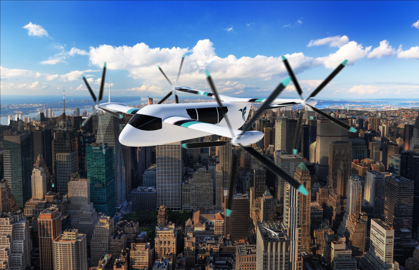
- 8 a.m.–5 p.m. on Saturday, 9 January and Sunday, 10 January 2027, at the Hyatt Regency Orlando before the AIAA SciTech Forum 2027
- This comprehensive face-to-face course will give participants a detailed overview of the design process for Rotorcraft and eVTOL Aircraft, to include Aerodynamics, Rotor Aeromechanics, Wind Tunnel and Flight Testing, Conceptual Design and Sizing.
- All students will receive an AIAA Certificate of Completion at the end of the course.
OVERVIEW
The 2-day Rotorcraft and eVTOL Aircraft Design: Principles and Practice course provides a comprehensive introduction to the aerodynamic, aeromechanical, testing, and conceptual design principles that shape modern rotorcraft and electric vertical takeoff and landing (eVTOL) aircraft. Beginning with the fundamentals of rotor operation and eVTOL architectures, the course examines rotor and propeller aerodynamics, vehicle performance across hover, transition, and cruise, distributed electric propulsion, control and trim, structural dynamics, loads, and aeroelastic stability.
Participants will also explore how these principles are applied through wind-tunnel and flight testing, instrumentation, model correlation, and vehicle design and sizing. The course introduces conceptual-level methods for evaluating aerodynamics, geometry, weight, propulsion, stability, performance, and cost, and shows how these disciplines come together in sizing algorithms, design frameworks, and trade-space exploration. Real-world examples, including quadrotor and tiltrotor sizing, help connect the underlying theory to practical rotorcraft and eVTOL design decisions.
LEARNING OBJECTIVES
- Explain rotor aerodynamics using momentum theory and BEMT
- Compare rotor, propeller, and proprotor configurations, including coaxial and shrouded designs
- Calculate eVTOL performance and control across hover, transition, and cruise
- Identify key structural dynamics, loads, and aeroelastic stability considerations and know how to predict them
- Apply conceptual-level methods for aerodynamics, weights, propulsion, and cost to size a vehicle
- Use design frameworks and sizing algorithms for trade-space exploration and sensitivities
- Apply Froude and Mach scaling to plan wind-tunnel and flight test programs
- Describe instrumentation and test data correlation for rotors, blades, and motors
- [see below for detailed outline]
AUDIENCE
This course is intended for aerospace engineers, aircraft designers, researchers, and technical professionals involved in rotorcraft, eVTOL, advanced air mobility, or other vertical-flight aircraft. It will be particularly valuable for engineers working in aerodynamics, aeromechanics, propulsion, structures, flight dynamics and controls, vehicle performance, conceptual design, or flight and wind-tunnel testing who want a broader understanding of how these disciplines interact in rotorcraft and eVTOL aircraft development.
The course is also appropriate for engineers and technical managers transitioning into the rotorcraft or eVTOL field who want to understand the fundamental design principles, major configuration and sizing decisions, and practical considerations involved in developing and testing vertical-flight vehicles. A general background in aerospace engineering or a related technical discipline is recommended.
REGISTRATION FEES (Register Here)
AIAA Member: $745 USD
Student: $395 USD
Non-Member: $945 USD
Register for the course only or as an add-on to Conference registrations. Course participation is in-person only.
CONTACT
Please contact Lisa Le, Education Manager, for questions about the course or group discounts (for 5+ participants).
Rotors
I. Introduction
– Why eVTOL? Why now? A brief history
– State-of-the-art in eVTOL aircraft, batteries, and electric motors
– Single vs. distributed electric propulsion
– The connection to infrastructure (vertiports, charging, operation)
II. Rotor Aeromechanics
– How a rotor works — fundamentals
– Momentum theory
– Blade element momentum theory (BEMT)
– VTOL aerodynamics and performance across flight regimes (hover, transition, cruise)
– Rotors vs. propellers vs. proprotors
– Coaxial and shrouded rotors
– Major rotor design decisions: number of blades, precone, torque offset, undersling, delta3, etc.
– Sizing examples: quadrotor and tiltrotor
– eVTOL control and trim
– Rotorcraft comprehensive analysis
– Rotorcraft structural dynamics, loads, and aeroelastic stability (flutter)
Conceptual Design and Sizing
– Requirements definition
– Configurations
– Conceptual-level methods
– Atmosphere
– Aerodynamics
– Geometry
– Weights
– Propulsion
– Stability and performance
– Cost
– Setting up sizing and performance algorithms
– Design frameworks
– Sizing
– Trade-space exploration, sensitivities
Wind Tunnel and Flight Testing
– Scale parameters for VTOL testing: Froude and Mach scaling
– Rotor/blade/wing structural testing
– eVTOL blade fabrication
– Instrumentation
– Wind tunnel testing
– Motor and rotor/propeller testing
– Test data processing and model correlation
– eVTOL flight testing
Aerodynamics
– Framing: why UAM aero is its own problem
– Hover and low-speed aerodynamics
– Transition and the conversion corridor
– Cruise and interactional aerodynamics
– Modeling, simulation, and test
– Constraints and open problems
Soft copy course notes will be made available 3-5 days prior to the course event. You will receive an email with detailed instructions on how to access your course notes. Since these notes will not be distributed on site, AIAA and your course instructor highly recommend that you bring your computer with the course notes already downloaded.
Dr. Seyhan Gul is a Senior Staff Rotor Dynamics Engineer at Archer Aviation. He holds M.S. and Ph.D. degrees in Aerospace Engineering at the University of Maryland. His research focused on aeromechanics modeling of tiltrotor aircraft and prediction of high-speed aeroelastic stability and loads of hingeless hub proprotors. He developed Alfred Gessow Rotorcraft Center’s new comprehensive analysis code UMARC-II. Gul also led a graduate team in 2018-2019 to design an extreme-altitude mountain rescue vehicle, which won the 36th VFS Student Design Competition. Before his Ph.D, he completed another Master’s Degree at the Middle East Technical University in Ankara/Turkey and worked at Turkish Aerospace. There, he focused on comprehensive analysis and rotor/airframe loads predictions of T625 Gökbey Helicopter. Gul is a recipient of the prestigious Vertical Flight Foundation Scholarship and best paper awards in dynamics session at VFS Forum 77 and AIAA SciTech Forum in 2021.
Francesco Giannini has been an Aircraft Configurator for the past 19 years at Aurora Flight Sciences, a Boeing subsidiary. There, he worked on a variety of advanced concepts including several V/STOL vehicles like the Pegasus eVTOL, and DARPA’s XV-24 and SPRINT. Francesco earned a BS and a MS in Aerospace Engineering from CalPoly San Luis Obispo (2006). He volunteers as a docent at the National Air and Space Museum annex in Chantilly, VA, and is currently an Associate Fellow of the AIAA.
Shashank Maurya is currently a Staff Propeller Dynamics Engineer at Archer where he focuses on the flight test loads. He previously worked at AIBOT as Aerodynamics engineer involving the design and testing of 500-lb tandem tilt wing prototype aircraft. Shashank completed his Ph.D. in Aerospace Engineering from the University of Maryland where his research was focused on the investigation of aeromechanics of high-speed single main rotor compound rotorcraft through wind tunnel testing and comprehensive analysis. He was part of the winning team in 36th VFS Graduate Design Completion. He is also a recipient of the AIAA Orville and Wilbur Wright Graduate Award in 2022.
Nicholas Peters earned his Ph.D. from Embry-Riddle Aeronautical University in 2022. For his Ph.D., Dr. Peters collaborated with the HPCMP CREATE-AV Helios development team at NASA Ames, focusing on high-fidelity surrogate modeling for both fixed-wing and rotorcraft store separation. After completing his degree, he worked in the Aeromechanics Office at NASA Ames, primarily utilizing high-performance computing to enhance vehicle modeling in the early stages of eVTOL conceptual design. In late 2025, Dr. Peters joined Archer Aviation as a Sr. Aerodynamics Engineer, focusing on propeller aerodynamics. Key areas of research interest include flight dynamics, turbulence modeling, automated grid generation, and high-fidelity CFD rotorcraft performance predictions.
AIAA Training Links
-
For information, group discounts,
and private course pricing, contact:
Lisa Le, Education Specialist ([email protected])