
Charbel Farhat to Receive the 2026 Daniel Guggenheim Medal for Pioneering Advances in Aerospace Computational Mechanics Written 5 January 2026
In This Section
FOR IMMEDIATE RELEASE
January 5, 2026 – Reston, Va. – Charbel Farhat has been awarded the 2026 Daniel Guggenheim Medal for pioneering advances in the computational mechanics of fluid-structure interaction, transforming simulation methodologies and enabling major breakthroughs in aircraft design and optimization. He will receive the prestigious award during AIAA AVIATION Forum 2026, 8–12 June, San Diego, Calif.
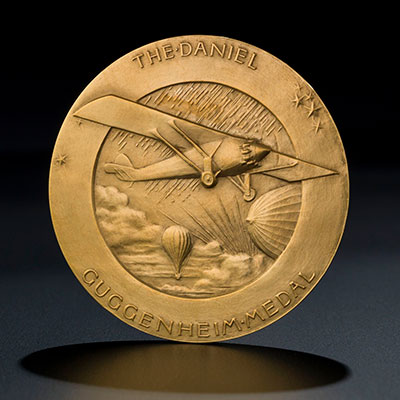
The Daniel Guggenheim Medal was established in 1929 to honor innovators who make notable achievements in the advancement of aeronautics. Its first recipient was Orville Wright. The medal is jointly sponsored by the American Institute of Aeronautics and Astronautics (AIAA), the American Society of Mechanical Engineers (ASME), SAE International (SAE), and the Vertical Flight Society (VFS).
“During his 36-year academic career, Farhat has made outstanding contributions to fixed wing aeroelasticity and supersonic parachute inflation dynamics that have advanced the safety and practicality of aviation; and that of related driving forces of global technology development and innovations with significant economic and social benefits. He has pioneered computational methods that have enabled the solution of safety-critical aero-elastic and aero-servo-elastic problems. He has introduced physics-based machine learning into the development of high-fidelity multidisciplinary design analysis and optimization (MDAO) frameworks to allow them to be computationally tractable and thus attractive to designers” said George Springer, Professor of Aeronautics and Astronautics, Stanford University, and nominator.
“On behalf of the Guggenheim Medal Board, I would like to extend my heartfelt congratulations on this well-deserved recognition. Prof. Farhat’s outstanding contributions to computational mechanics, aero-elasticity and aircraft design/optimization have had a significant impact on both the aerospace industry and the broader community,” added George Kardomateas, Professor of Aerospace Engineering at Georgia Institute of Technology, and chair, Guggenheim Medal Board.
Charbel Farhat is the Vivian Church Hoff Professor of Aircraft Structures at Stanford University and a professor in the Institute for Computational and Mathematical Engineering. He chaired Stanford’s Department of Aeronautics and Astronautics from 2008 to 2023 and held its inaugural Spilker Chair. He has directed major research centers, including the KACST-Stanford Center of Excellence for Aeronautics and Astronautics and the Army High Performance Computing Research Center, and served on national advisory bodies such as the U.S. Air Force Scientific Advisory Board and the Space Technology Industry-Government-University Roundtable. Recognized by the U.S. Navy as a Primary Key-Influencer, he flew with the Blue Angels in 2014.
Farhat earned his Ph.D. from UC Berkeley and is an AIAA Fellow. He is a member of the U.S. National Academy of Engineering, the UK’s Royal Academy of Engineering, and the Lebanese Academy of Sciences. His honors include the Vannevar Bush Faculty Fellowship, three honorary doctorates, the Kuwait Prize, and major distinctions in computational mechanics and high-performance computing, including the IEEE Gordon Bell and Sidney Fernbach Awards. A Fellow of multiple professional societies, he has also received French national honors. Farhat has authored over 650 publications, served as Editor-in-Chief of two leading journals, and contributes broadly to research in fluid–structure interaction, CFD, structural mechanics, high-performance computing, and physics-based machine learning.
Past recipients of the Guggenheim Medal are some of the greatest names in aerospace, including Holt Ashley, Lawrence Bell, William Boeing, James Doolittle, Donald Douglas, Charles Stark Draper, Hugh Dryden, Robert Goddard, Jerome Hunsaker, Theodore von Kármán, Charles Lindbergh, Glenn Martin, Frank Robinson, Burt Rutan, Igor Sikorsky, and Walter Vincenti, among many others.
For more information about the AIAA/ASME/SAE/VFS Daniel Guggenheim Medal, contact Patricia A. Carr, Guggenheim Secretary, at [email protected].
AIAA Media Contact: Rebecca Gray, [email protected], 804-397-5270
About AIAA
The American Institute of Aeronautics and Astronautics (AIAA) is the world’s largest aerospace technical society. With nearly 30,000 individual members from 91 countries, and 100 corporate members, AIAA brings together industry, academia, and government to advance engineering and science in aviation, space, and defense. For more information, visit www.aiaa.org, or follow AIAA on Twitter, Facebook, LinkedIn, and Instagram.
About ASME
ASME helps the global engineering community develop solutions to real world challenges. Founded in 1880 as the American Society of Mechanical Engineers, ASME is a not-for-profit professional organization that enables collaboration, knowledge sharing and skill development across all engineering disciplines, while promoting the vital role of the engineer in society. ASME codes and standards, publications, conferences, continuing education and professional development programs provide a foundation for advancing technical knowledge and a safer world. For more information visit www.asme.org.
About SAE International
SAE is the leader in connecting and educating mobility professionals to enable safe, clean, and accessible mobility solutions. SAE International is a global association of more than 128,000 engineers and related technical experts in the aerospace, automotive and commercial-vehicle industries. Our core competencies are life-long learning and voluntary consensus standards development. SAE International’s charitable arm is the SAE Foundation, which supports many programs, including A World In Motion® and the Collegiate Design Series. For more information visit www.sae.org.
About The Vertical Flight Society
Founded as the American Helicopter Society in 1943, the Vertical Flight Society today advocates, promotes and supports global vertical flight technology and professional development. For 80 years, the Society has provided leadership for the advancement of vertical flight. For more information, visit www.vtol.org or follow us on Twitter at @VTOLsociety.