
2026 AIAA von Kármán Lecture in Astronautics on Learning and Controlling Autonomous Space Systems to be Presented by Maruthi Akella from University of Texas at Austin Written 31 March 2026
In This Section
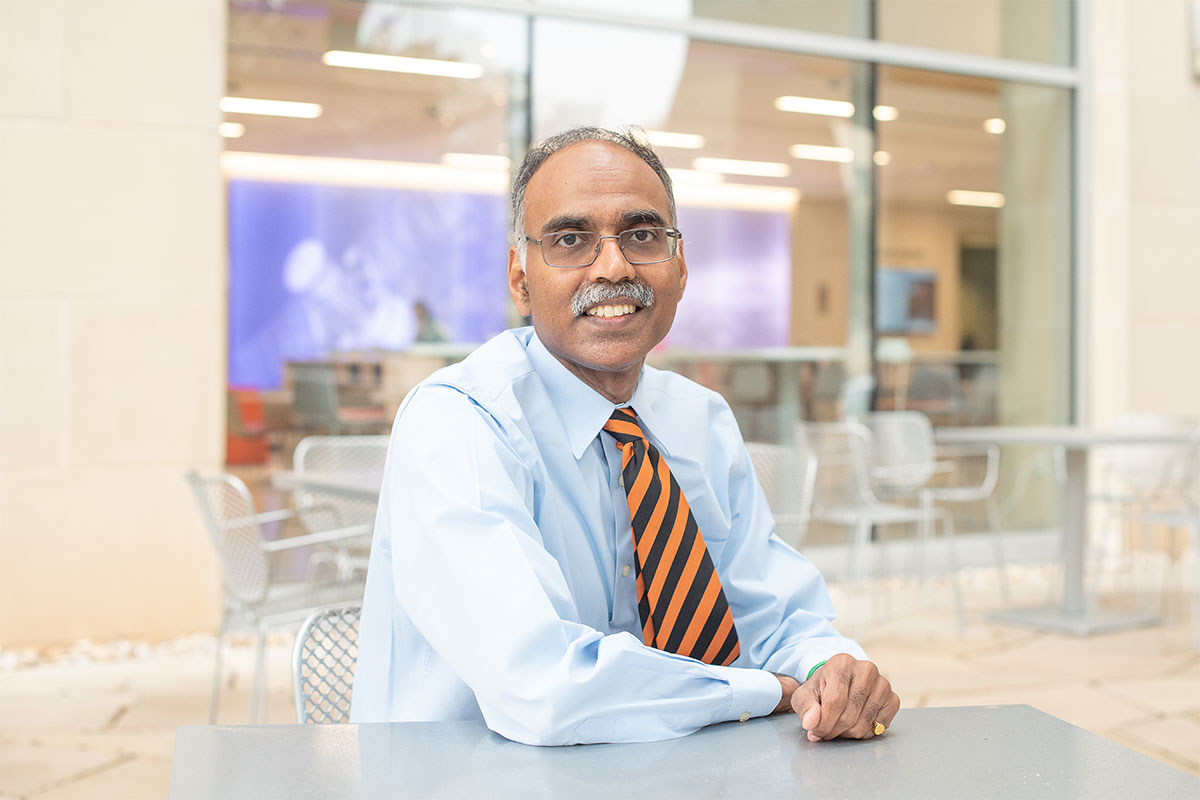
Maruthi Akella, Professor of Aerospace Engineering and Engineering Mechanics, University of Texas (UT) Austin | Credit: AIAA–©
FOR IMMEDIATE RELEASE
March 31, 2026 – Reston, Va. – AIAA is pleased to announce the 2026 AIAA von Kármán Lecture in Astronautics is awarded to Maruthi Akella, Professor of Aerospace Engineering and Engineering Mechanics at the University of Texas (UT) Austin, where he holds the Cockrell Family Endowed Chair in Engineering.
The lecture, “Opinion Dynamics, Learning, Trust, and Control of Autonomous Space Systems,” will be presented Wednesday, 20 May, at 12:15 p.m. ET, during ASCEND 2026, 19–21 May, Washington, D.C. The lecture will be delivered in person, as well as recorded. Registration for 2026 ASCEND is open now. Journalists can request a Press Pass online.
Autonomous space systems face significant challenges when operating under uncertainty, especially near other vehicles that may not cooperate. In applications like In-Space Servicing, Assembly and Manufacturing (ISAM), these systems must quickly learn, adapt, and make smart decisions in complex, unpredictable environments.
This lecture will showcase a framework for multithread learning designed to maintain spacecraft performance despite high uncertainty and fast variations. The approach builds on recently developed learning structures and trust metrics. During his lecture, Akella will illustrate the framework through ISAM examples in spacecraft guidance and proximity operations.
Akella’s research contributions have found several highly successful applications in astrodynamics and in the control of space systems and vision-guided robotics. His research group contributed to the onboard guidance algorithm for the Intuitive Machines IM-1 mission – the first U.S. moon landing in more than 50 years since the Apollo era.
Akella has published more than 260 research papers in peer-reviewed archival journals and conference proceedings. The major impacts of his work have been recognized through the AIAA Mechanics and Control of Flight Award, the AAS Dirk Brouwer Award, the IEEE-CSS Award for Excellence in Aerospace Control, and the Judith Resnik Space Award from the IEEE Aerospace and Electronic Systems Society.
In October 2024, the International Astronomical Union designated asteroid number 5376 – a nearly five-mile diameter-sized minor planet from the main asteroid belt as “Maruthiakella,” honoring Akella’s contributions to “many successful applications in astrodynamics.”
Akella is a Fellow of AIAA, IEEE, and AAS and holds the Academician rank with the International Academy of Astronautics. He currently serves as Editor-in-Chief for The Journal of the Astronautical Sciences.
Named in honor of Theodore von Kármán, a world-famous authority on aerospace sciences, this lectureship honors an individual who has performed notably and distinguished themselves technically in the field of astronautics.
Media Contact: Rebecca Gray, [email protected], 804-397-5270 cell
About AIAA
The American Institute of Aeronautics and Astronautics (AIAA) is the world’s largest aerospace technical society. With nearly 30,000 individual members from 91 countries, and 100 corporate members, AIAA brings together industry, academia, and government to advance engineering and science in aviation, space, and defense. For more information, visit www.aiaa.org, and follow AIAA on Facebook, Instagram, LinkedIn, and X/Twitter.