
Spacecraft Rendezvous and Proximity Operations Online
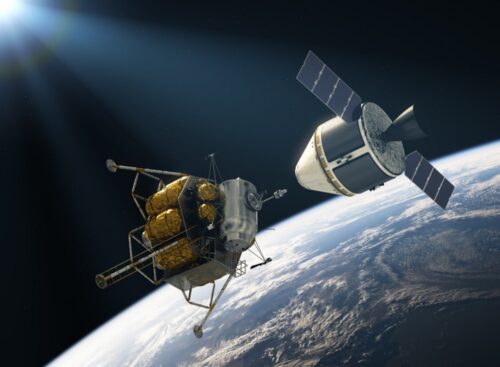
- This new essential course, in partnership with Johns Hopkins University, introduces students to the main elements of a Rendezvous and Proximity Operations (RPO) mission.
- All students will receive an AIAA Certificate of Completion and an additional Certificate of Completion from Johns Hopkins University at the end of the course.
OVERVIEW
The objectives of this course are to develop the general principles governing spacecraft proximity operations, rendezvous, and docking. Students will be introduced to topics such as near and far range rendezvous, natural motion circumnavigation, safe relative motion, phasing, Lambert Targeting, relative navigation (RelNav). After completing this six-week course, students will be able to conceptualize the operations of rendezvous and prox-ops missions such as the International Space Station (ISS) resupply, crew transfer, extra-vehicular activities, and on-orbit assembly/refueling. A basic knowledge of Newtonian Mechanics and Ordinary Differential Equations is expected.
Also, students will have optional self-paced readings, exercises, knowledge checks, etc. available in the Johns Hopkins learning platform to enhance the course experience.
LEARNING OBJECTIVES
- Describe the various phases of a typical Rendezvous and Proximity Operations (RPO) Mission
- Discuss operational issues and constraints driving the design of an RPO strategy
- Explain the common methods available for the design of collision-safe RPO trajectories
- Analyze basic maneuvers for an RPO spacecraft
- Identify common relative navigation strategies
AUDIENCE
Government, industry, academic, or commercial stakeholders of space systems without detailed background of space mission design and navigation.
CONTACT: Please contact Lisa Le or Customer Service if you have any questions about the course or group discounts.
OUTLINE
• Module 1: Introductory Concepts
o RPO Basics
o RPO Definitions and Nomenclature
o RPO Sequence of Operations
o Orbital Mechanics Background
• Module 2: RPO Mission Phases
o Mission Phases from Launch to Rendezvous
o RPO Launch Windows
o Rendezvous between Adversarial Vehicles
o Operational Constraints for RPO Missions
• Module 3: Relative Motion Modeling and Relative Orbits
o RPO modeling with Clohessy-Wiltshire Equations
o Natural Relative Motion: Circumnavigation, Fly-around, V-bar-toR-bar Hop, Hold points, etc.
o Safety Ellipse Design
• Module 4: RPO Terminal Guidance
o Lambert Guidance
o Two-Impulse Rendezvous Trajectories
o Multi-impulse Glideslope Trajectories
o Safe Terminal Approach Policies
• Module 5: Relative Navigation for RPO Maneuver Planning
o Operation of Relative Navigation Sensors: Optical, Infra-red, and LiDAR
o RelNav Sensor Tasking during RPO Near and far Rendezvous
o Least Squares Orbit Estimation
o Least Squares OD applied to Relative Orbits
• Module 6: Case Study of the Northrop Grumman Mission Extension Vehicle (MEV)
o Emerging Interest in Satellite Servicing and Refueling
o Servicing at GEO with MEV
o MEV ConOps
o MEV RPO Sensor Suite


Dr. Pradipto Ghosh is a member of the Senior Professional Staff at the JHU APL Space Exploration Sector. His interests include Astrodynamics, Navigation, Space Logistics, Stochastic Optimal Control, and Differential Games. Dr. Ghosh serves on the AIAA Astrodynamics Technical Committee, and on the editorial boards of the Journal of Spacecraft and Rockets (AIAA) and the Journal of the Astronautical Sciences (AAS). He earned his doctorate in Aerospace Engineering from the University of Illinois, Urbana-Champaign.
AIAA Training Links
-
For information, group discounts,
and private course pricing, contact:
Lisa Le, Education Specialist ([email protected])