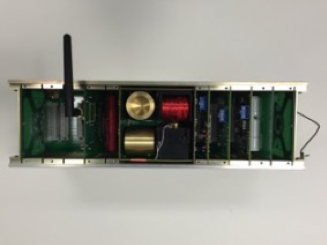
Brought to AIAA by Teaching Science and Technology, Inc. (TSTI), this Integrated CubeSat Engineering course examines the application of Systems Engineering tools and techniques that will provide participants with an understanding of the scope of the skills, industry standards, information, and tools necessary to plan a credible CubeSat Development Program. Emphasis is on practice over theory using a fully-functional (hardware and software) desktop (non-flight) CubeSat as the system of interest. The course uses the 3U EyasSAT3™ (ES3) desktop satellite (Figure 1), and it follows the progression of a hypothetical CubeSat mission – NanoMet – designed to deliver large scale meteorological imagery from LEO. NanoMet serves as an end-to-end system engineering and project management training platform to examine issues that develop during each phase of a project lifecycle.
Figure 1. EyasSAT3 Layout and Design
The course is organized along the lines of a real space mission, starting with Pre-Phase A concept development and then progressing from Phase A to D, introducing systems engineering artifacts that would be developed at each major milestone and providing hands-on examples using the NanoMet mission. NanoMet, based on the ES3 platform, is designed to conform to the 3U CubeSat standard in terms of form and fit and includes all standard spacecraft bus functions (power, data handling, communication, and 3-axis attitude determination and control). All hardware was designed to be for use around the world and is “ITAR-free,” (it is not space-qualified or even qualifiable). Participants are provided with key lectures and resources and through a variety of in-class exercises will learn by doing.
Image Courtesy of Lockheed Martin
Instructed by Bong Wie, Professor Emeritus of Aerospace Engineering at Iowa State University
- This course introduces the fundamental problems of classical astrodynamics, such as the two-body problem, Kepler’s problem, Lambert’s problem, and orbit perturbations
- This course will include astrodynamical application examples to enhance the learning experience: ballistic missile and lunar trajectories; orbital transfer, intercept, and rendezvous guidance problems; orbit analysis and simulation of LEO and GEO satellites; hypersonic entry guidance and counter hypersonics
- It will further explore the technically challenging problem of developing a space-based missile defense system (e.g. the Golden Dome).
- All students will receive an AIAA Certificate of Completion at the end of the course
Synopsis:
The “Hybrid Rocket Propulsion” short course is essential for all professionals specializing in chemical propulsion. The mechanisms associated with hybrid combustion and propulsion is diverse and affect our abilities to successfully advance and sustain the development of hybrid technology. It is our ultimate goal to promote the science of hybrid rocketry which is safe enough to be used in both academia and the private sector. A historical demonstration of hybrid rocket capability is the 2004 X-prize winner SpaceShipOne. This technology can also be used in outreach activities when used in conjunction with hands-on design projects and payload launches that involve student teams. Practically, interest in hybrid rocketry can thus be translated into increased awareness in science and technology, thus helping to alleviate the persistent attrition in our technical workforce. This course reviews the fundamentals of hybrid rocket propulsion with special emphasis on application-based design and system integration, propellant selection, flow field and regression rate modeling, solid fuel pyrolysis, scaling effects, transient behavior, and combustion instability. Advantages and disadvantages of both conventional and unconventional vortex hybrid configurations are examined and discussed.
Key Topics:
- Introduction, Classification, Challenges, and Advantages of Hybrids
- Similarity and Scaling Effects in Hybrid Rocket Motors
- Flowfield Modeling of Classical and Non-Classical Hybrid Rockets
- Solid Fuel Pyrolysis Phenomena and Regression Rate: Mechanisms & Measurement Techniques
- Combustion Instability and Transient Behavior in Hybrid Rocket Motors
- Metals, Other Energetic Additives, and Special Binders Used in Solid Fuels for Hybrid Rocket Applications
Who Should Attend:
This short-course is aimed at bringing together professionals with mutual interest in chemical combustion and propulsion, including modern techniques for measuring hybrid rocket performance, flame and flow field modeling, testing, and stability analysis. Our objective is to present and discuss fundamental theory alongside research findings with emphasis on unsolved problems, open questions, and benchmark tests. The course will provide a platform for learning and exchanging hybrid rocket experiences in the hope of stimulating further interactions and future collaborations.
Instructed by Dr. Reynard de Vries, Dr. Phillip Ansell, Mr. Charles Lents and Dr. Jonathan Gladin
- 2-Day Course, held in conjunction with the AIAA AVIATION Forum 2026 in San Diego, California
- Monday/Tuesday 8–9 June 2026
- Updated for 2026 with the latest developments in electrified propulsion
- All students will receive an AIAA Certificate of Completion at the end of the course
Instructed by Andrew Chaikin, acclaimed space historian and author of “A Man on the Moon”
- Principles of Success in Spaceflight reveals critical human behaviors essential for success in spaceflight projects. Presented by acclaimed space historian Andrew Chaikin, author of A Man on the Moon (the main basis for Tom Hanks’ 1998 Emmy-winning HBO miniseries From the Earth to the Moon), the course leverages human behavior lessons from NASA’s history to guide spaceflight professionals on how to invite success and avoid failure.
- All students will receive an AIAA Certificate of Completion at the end of the course.
Instructed by experts from Delft University of Technology
- Learn about the fascinating interaction between aerodynamics, structures and control, their modelling challenges, and their impact on the aircraft behavior.
- All students will receive an AIAA Certificate of Completion at the end of the course
Designing Space Missions and Systems examines the real-world application of the entire space systems engineering discipline. Using a process-oriented approach, the course starts with basic mission objectives and examines the principles and practical methods for mission design and operations in depth. Interactive discussions focus on initial requirements definition, operations concept development, architecture trade-offs, payload design, bus sizing, subsystem definition, system manufacturing, verification, and operations. This is a hands-on course with a focus on applications. Design exercises are conducted to give first-hand experience with the techniques presented and gain experience with mission design trade-offs.