
Chief Executive Officer of Aquarian Space, TEDx speaker and a serial entrepreneur, Kelly Larson, ABD, is an innovator at the intersection of business, science and leadership. As a farm girl grown into a Yoga and transformation entrepreneur turned space CEO, she trail-blazes new business ventures and connects people and ideas across the globe. Kelly is widely known for her innovative approaches to business and her strategic range. She currently specializes in aerospace market-ready development strategies with an emphasis in collaborative international partnerships and high-level entrepreneurial ventures. Kelly sees that we can only develop a strong interplanetary economy together.
People Category: AIAA SciTech Forum 2021
Garret Westlake
Dr. Garret Westlake is leading the transformation of Virginia Commonwealth University into one of the nation’s leading universities for cross-disciplinary collaboration and innovation. As executive director of the da Vinci Center for Innovation, Dr. Westlake advances university-wide student innovation and entrepreneurship through curriculum as well as through curated experiential education opportunities. Dr. Westlake is also a Visiting Scholar at Northern Michigan University’s SISU Institute for Innovation and Educational Transformation.
Jillian Patricia Pirtle
Jillian Patricia Pirtle is a professional Stage & Opera Artist that has had a great love & passion for the Arts since the tender age of three. Jillian has sparkled in the performing arts as a vocalist, actress, model, dancer and personality. Jillian received her formal training from the High School of Creative and Performing Arts where she majored in Vocal Music Performance and minored in Instrumental Violin and Dramatic Performance. Jillian received her BFA Degree in Musical Theater & Operatic Performance from the University of the Arts in 2004. While attending the University, Jillian was formally inducted into the Marian Anderson Society as a Marian Anderson Scholar & Classical Vocalist. Jillian also holds a degree in History & is a licensed Historian with the state of Pennsylvania. With Jillian’s Aspirations and Goals of starring on Broadway & The Metropolitan Opera, some of the shows that she has been featured are Porgy & Bess (Bess), La Boheme (Muzetta), Gianni Scicci (Zeta), ‘Purlie’ (Luttliebelle), ‘Ragtime’ (Sarah), Thoroughly Modern Millie’ (Muzzy Van Hosmere) ‘Hair’ (Dionne), ‘Ain’t Misbehavin’ (Nell), ‘The Mikado’ (Katisha), ‘Working’ (Maggie Holmes), ‘Little Shop of Horrors’ (Crystal), ‘Loves Labours Lost’ (Jaquenetta) and ‘Funny House of A Negro’ (Funny Lady/Land Lady). On December 11, 2010 Jillian was crowned as the New Miss Black Pennsylvania USA 2011 to represent the great state of Pennsylvania in the National Miss Black USA Pageant Inc. On August 8, 2011 Jillian wowed the National Audience in Washington Dc and brought home two National Titles. Jillian was then blessed with the honor, crown and title becoming the new Miss Pennsylvania Essence 2012. Then on December 16, 2012 was newly Crowned with the title of Miss Pennsylvania Royal Dynasty 2013. Jillian continued with her platform of the Arts Empowerment Project and proved victorious as she captured her final title as Miss International Supreme Queen. In January of 2013 Jillian became the Chief Operating Officer of The National Historical Marian Anderson Residence Museum & Society, and in 2018 due to the sad passing of Lady Blanche Burton Lyles the founder of The National Marian Anderson Museum & Historical Society Jillian became the museum & organizations CEO. In addition to all she is and does, Jillian is also the CEO of Royal One Productions LLC Entertainment Company and is the Host of the National Arts In Color Television Show.
Richard A. Baugh
Richard A. Baugh is the Treasurer of the Howard Baugh Chapter of the Tuskegee Airmen, Inc. (HBC-TAI) and son of the namesake of this organization based in Petersburg, VA. HBC-TAI is one of 55 nationwide chapters of Tuskegee Airmen, Inc. whose mission is to preserve the legacy of the WWII heroes known as the “Tuskegee Airmen” and to use that legacy to inspire youth to pursue careers in STEM, Aviation, Aeronautics, and Aerospace.
Howard Lee Baugh was born in Petersburg, VA on January 20, 1920. He attended public schools in Petersburg and Brooklyn, NY and graduated from Virginia State College (University) in 1941. Baugh entered the U.S. Army Air Corps as an Aviation Cadet in March 1942. He completed pilot training at Tuskegee Army Air Field in November 1942 (Class 42-J-SE) and was commissioned as a 2nd Lieutenant.
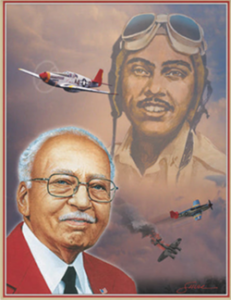
In July 1943, Baugh was deployed to Sicily as one of the first group of replacement pilots for the 99th Pursuit Squadron. Flying P-40 & P-51 Fighter aircraft out of Sicily and Italy during WWII, he flew 136 combat missions. On January 27, 1944, Baugh was credited with 1.5 Aerial Victories while the 99th Pursuit Squadron protected the Allied occupied Anzio, Italy beachhead from aerial attack by German Focke-Wulf FW-190 fighters.
For his 16 months of combat during WWII, Baugh was awarded the Distinguished Flying Cross; Air Medal with three Oak Leaf Clusters; European-African Middle Eastern Campaign Medal; World War II Victory Medal; National Defense Service Medal; and Distinguished Unit Citation.
After his deployment, Baugh returned to Tuskegee as a Flying Instructor and soon became Director, Flying Training, Tuskegee Army Air Field.
After the war, Baugh remained in the military as a Command Pilot and career officer for more than 25 years. During that time he amassed nearly 6,000 pilot hours, including 240 in combat and 1,100 in jet aircraft.
Baugh retired as a Lieutenant Colonel from the USAF on June 30, 1967. He then embarked on a second career joining Eastman Kodak Company in Rochester, NY. Baugh retired from Kodak in 1984 and moved back to Petersburg with his wife, Constance.
Throughout his military career, Baugh piloted the following military aircraft: PT-13, PT-17, BT-13, L-20, AT-6, P-40, P-47, P-51, B-25, B-26, C-45, C-47, B-57, B-66, T-33, F-80, and SA(HU)-16. Long after retiring from the military, Baugh was given the opportunity to ride in the 2nd seat of a two-seater USAF F-15D Eagle in 1997 (at age 77) and a two-seater USN F/A-18F Hornet with the Blue Angels in 1998. In both cases, once airborne the aircraft controls were turned over to him for about 20 minutes. In the case of the F-15D, Baugh was able to fly the aircraft out over the Atlantic Ocean and break the “sound barrier” for the first and only time in his life.
Once retired, Baugh became a much sought after Speaker for his unique insights into the Tuskegee Airmen Experience. He spoke at Schools; Colleges & Universities; Small Companies; Large Corporations; Organizations; Groups; and Military Bases throughout the US, Europe, and even in Greenland and Iceland.
Howard Lee Baugh passed away on August 23, 2008. He was preceded in death by his wife of 54 years, Constance, and his older brother William. He was laid to rest with Full Military Honors at Arlington National Cemetery next to his wife.
The legacy of Howard Lee Baugh will live on through HBC-TAI; his (3) sons: Howard, David, & Richard; (2) daughters-in-law; (4) grandchildren, (4) great grandchildren; (1) brother; (1) brother-in-law; many nieces, nephews, cousins, friends, admirers, and countless others around the world whose lives he touched and inspired.
DOTA George E. Hardy
DOTA George E. Hardy in March 1943, at the age of 17, passed the written and physical examinations for the US Army Aviation Cadet program. In July 1943 he was called to active duty and sent to Keesler Army Air Field, Biloxi, Mississippi, for basic training. In September 1943 he was assigned to the 320th College Training Detachment at Tuskegee Institute in Alabama. His group was scheduled to take college-level courses, at Tuskegee Institute, for a period of five months. This training was cut short in the beginning of December, as his group was transferred to Tuskegee Army Air Field (TAAF) for Aviation Cadet training, as part of Class 44-H. In September 1944 he graduated as a single-engine pilot and was commissioned a Second Lieutenant in the U.S. Army. In November he was transferred to Walterboro AAF in South Carolina for combat flying training in P-47 aircraft. This combat flying training was completed in early February 1945, and he was shipped overseas to Italy. In Italy, he was assigned to the 99th Fighter Squadron, 332nd Fighter Group, where he flew 21 combat missions over Germany in P-51 aircraft. Those missions were mainly high-altitude escort missions of heavy bombers, but many of the missions also included strafing of ground targets. He returned from Italy in August 1945 and served at TAAF, until it closed in the summer of 1946. In July 1946 he was transferred to Lockbourne AAF, Ohio where he was assigned to the 99th Fighter Squadron, flying P-47 aircraft. He was discharged from active duty in November 1946.
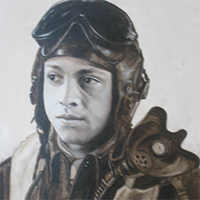
He attended New York University, School of Engineering, in the Bronx, from September 1947 to May 1948. He was recalled to active duty at Lockbourne Air Force Base (LAFB), Ohio, in June 1948. He was assigned to the 301st Fighter Squadron, 332nd Fighter Group, flying P-47 aircraft. In September 1948 he was reassigned as a student in the Airborne Electronics Maintenance Officers Course at Keesler AFB, Mississippi. The course of study covered radar and long-range navigational equipment on fighter and bomber aircraft. He graduated in August 1949. In July 1949 the USAF instituted racial integration and personnel at Lockbourne AFB were reassigned to Air Force bases worldwide. After graduation in August 1949, he was transferred to the 19th Bomb Group (B-29 Aircraft) on the island of Guam. He was further assigned to the 28th Bomb Squadron as a maintenance officer. His primary job was supervising about 25 airmen in maintenance of electronic equipment on the assigned aircraft. As a pilot he was also required to fly and was assigned as a copilot on a B-29 aircrew. The Korean War started 25 June 1950, and the 19th Bomb Group was transferred to Kadena Air Base, Okinawa. He flew 45 combat missions over Korea in the B-29 aircraft.
In March 1951 he returned to the states and was assigned to 6th Bomb Wing, at Walker AFB in New Mexico, as a maintenance officer. In June 1951 he was transferred to Lowry AFB, Denver, Colorado for seven months training as an Armament Systems maintenance officer, specifically on B-36 aircraft. The B-36 aircraft was the largest aircraft in the Air Force, capable of intercontinental bombing missions without refueling. The armament systems field included not only the electronic navigational and bombing systems but also included the retractable gun turrets and maintenance and loading of the bomb bays. After the training at Lowry he was transferred back to Walker AFB and in December 1952 he was transferred to Carswell AFB, Ft Worth, Texas. He became part of the 42nd Bomb Wing (B-36 aircraft) and in March 1953 the wing was transferred to Limestone AFB, Maine. He served as a maintenance officer in the 42nd Armament and Electronics Maintenance Squadron (AEMS), until August 1955.
In August 1955 he transferred to the United States Air Force Institute of Technology at Wright Patterson AFB, Dayton Ohio. He entered the undergraduate engineering program and in August 1957, received a Bachelor of Science Degree in Electrical Engineering.
In September 1957 he was assigned to the 3rd AEMS, 3rd Bomb Wing (B- 57, Canberra aircraft) at Johnson Air Base, Japan. He was soon assigned as Maintenance Supervisor, a position he held for almost 3 years. The 3rd Bomb Wing areas of operations were in Japan, Korea and Okinawa. He became jet-qualified as a pilot and in 1959 he received the aerial rating of Command Pilot. In June 1960 he was promoted to the grade of Major.
In November 1960 he transferred to Plattsburgh AFB, New York. He was assigned as Squadron Commander of the 4108th AEMS, in the 4108th Air Refueling Wing (KC–97aircraft). In the second half of 1962 his squadron held the 8th Air Force trophy for best AEMS squadron. In November 1962 he was notified by the Air Force Institute of Technology of his eligibility to apply for a new graduate level systems engineering course specializing in reliability engineering. He applied for the course and was reassigned, in January 1963, to the USAF Institute of Technology, at Wright Patterson AFB, Dayton Ohio. In August 1964 he graduated with a Master of Science Degree in Systems Engineering – Reliability.
In September 1964 he was assigned to the Electronic Systems Division of Air Force Systems Command, at Hanscom AFB, Massachusetts. In 1965 he was promoted to the grade of Lt. Col. In August 1966 he was assigned as Chief of Engineering and Program Manager, for the Development, Installation and Cutover of the 490L Overseas AUTOVON (AUTOmatic VOice Network) Communications Switches, part of the Department of Defense first worldwide direct dial telephone system. The AUTOVON services within the continental United States was provided by the various telephone companies. With completion of the overseas switches, the Department of Defense and other government agencies would have almost worldwide, direct dial telephone access. In June 1969, four 490L switches in Europe and one 490L switch in Panama were successfully cutover.
At the end of 1969 he received notice of a flying assignment in Vietnam and was provided with refresher flight training as an AC-119K Gunship Aircraft Commander. He was assigned to the 18th Special Operations Squadron at Phan Rang Air Base in Vietnam in April 1970. Although the squadron headquarters was at Phan Rang Air Base, the aircraft were located at two operating locations, one at Udorn Air Base, in Thailand, and the other at DaNang Air Base in Vietnam. He was assigned as the Operating Location Commander at Udorn Air Base, Thailand through August 1970. Missions were flown at night over northern Laos searching for truck traffic from North Vietnam. In September 1970 he was transferred to DaNang Air Base in Vietnam as Operating Location Commander. Missions were flown at night over central portions of Laos looking for truck traffic from North Vietnam. He flew 70 combat missions in AC -119K Gunship aircraft,
In May of 1971 he was assigned to the Inspector General’s office at Air Force Systems Command, Andrews AFB in Maryland. He served in the IG’s office until November 1971 when he retired with the rank of Lieutenant Colonel.
His decorations include the Distinguished Flying Cross with Valor, the Air Medal with eleven (11) Oak Leaf Clusters, and the Commendation Medal with one Oak Leaf Cluster.
Teresa Kline
Ms. Teresa Kline is a program manager within NASA’s Office of the Engineer. In her role, Ms. Kline represents the Office of the Chief Engineer in the Agency’s efforts in model-based engineering, model-based systems engineering, and digital transformation. She also leads and advises several teams in these efforts, as well as an effort at identifying engineering tools, to provide the Agency with the ability to consolidate and provide a common tool set for use within the engineering community.
Prior to this role, Ms. Kline was the Associate for Strategy in the Programs Office at NASA’s Armstrong Flight Research Center, in Edwards, California. Ms. Kline led discussions
on strategy for the Center, advising the Director of Programs. Ms. Kline previously was detailed to the Office of the Chief Technologist, where she supported the development of the Agency’s roadmaps, which were published in 2015. She also was the liaison to the National Academies of Science, Engineering, and Medicine in the development and execution of several meetings, culminating in a workshop on innovation. Ms. Kline transferred to Armstrong Flight Research Center in 2007, as the Deputy Director for Aeronautics. She also held positions in business development at AFRC. Prior to hertransfer to AFRC, Ms. Kline was employed at NASA’s Glenn Research Center, working in propulsion- related testing in aeronautics and space.
Ms. Kline began her career with the US Army Research Laboratory, formerly Aviation Systems Command, which had offices at Glenn Research Center and Langley Research Center. In her 15 years with the Army, Ms. Kline analyzed and tested every engine supporting the Army at that time, including the certification of the T800 and the design of the LV100 for the M1A1 Abrams tank.
Ms. Kline’s formal education includes a Bachelor of Science degree in Mechanical Engineering in 1986 and a Master of Science in Mechanical Engineering in 1988. She lives in Tehachapi, California.
Jeff Laube
Jeff Laube is a senior project engineer with the Launch Systems Division, which is part of Civil and Commercial Launch Projects at The Aerospace Corporation in El Segundo, California. In his 30-plus years in the aerospace industry, Jeff has worked a variety of space launch and spacecraft development programs. At McDonnell Douglas, he was a mission designer for the Delta Launch Vehicle and PAM programs and a system engineering lead for the Delta Clipper Programs. At Lockheed Martin, Jeff was a Systems Operations Team Lead for the X-33/VentureStar Reusable Launch Vehicle Program. With Northrop Grumman, he was an element manager for the Project Prometheus/Jupiter Icy Moon Orbiter program and supported their Eagle satellite development program as system engineering lead and program manager. For AIAA, Jeff has served in a variety roles including Chair for the Orange County, California, section and recently has completed his term as Chair for the Space Operations and Support Technical Committee. Besides being recently honored as an Associate Fellow for the society, he is the Technical Program Chair for the upcoming AIAA SPACE 2012 Conference to be held Sept. 11-13 in Pasadena, California. He received his BS in Aerospace Engineering from California State Polytechnic University, Pomona, in 1981 and his MS in Aerospace Engineering from the University of Southern California in 1986.
Tejas Pruanik
Dr. Tejas Puranik is a Research Engineer at the Aerospace Systems Design Laboratory within the Georgia Institute of Technology. He holds a Bachelors degree in Aerospace Engineering from the Indian Institute of Technology in Mumbai and a Masters and PhD in Aerospace Engineering from the Georgia Institute of Technology. His research interests are in developing novel algorithms for air transportation systems safety and efficiency and the application of machine learning to solve complex engineering problems. He is a senior member of AIAA and a member of the AIAA Intelligent Systems and Air Transportation Systems Technical Committees.
Joe Cassady
Mr. Cassady is the Executive Director of Space Programs in the Washington DC Operations for Aerojet Rocketdyne where he helps oversee strategy development and architectures for future space and launch systems. He obtained his BS (1981) and MS (1983) in Aeronautics and Astronautics from Purdue University as well as a Graduate Certificate in Systems Engineering at the George Washington University in 2005. Mr. Cassady holds five U.S. Patents for Electric Propulsion technology. He has 37 years of experience in propulsion development and mission and systems analysis and has authored more than 60 technical papers dealing with electric propulsion, power and attitude control systems and mission analysis. Prior to coming to the Washington office, Mr. Cassady led flight project teams for the 26 kWe ESEX arcjet system (which still holds the record as the highest power electric propulsion system flown) and the EO-1 Pulsed Plasma Thruster system. In addition, he has served on a number of advisory groups for NASA and the DoD. He is an Associate Fellow of the AIAA, is Vice President of the Electric Rocket Propulsion Society and serves as Executive Vice President and member of the Board of Directors for ExploreMars, a 501c(3) non-profit dedicated to promoting STEM and human Mars exploration. It is his stated goal to see humans join their robotic precursors on the surface of the Red Planet.
Chris McLean
Chris McLean is a staff consultant at Ball Aerospace and is the Principal Investigator for NASA’s Green Propellant Infusion Mission (GPIM). His extensive expertise in propulsion and aerospace development have been critical to the GPIM program.
McLean began his career with Ball in 2004 where he served as the program manager for an in-space cryogenic propellant storage and delivery program, which included customer development and program execution. He has held multiple leadership positions during his time spent at Ball, including as the lead systems engineer for a robotic lunar lander effort. McLean is skilled in building highly motivated and multidisciplinary project teams and is well-known for his strong program management and ability to execute.
Prior to Ball, McLean was a propulsion research engineer specialist at Pratt & Whitney Space Propulsion.
McLean received a Ball Engineering Excellence Award in 2016 for his leadership and expertise in propulsion technology on GPIM. He holds a B.S. and M.S. in aeronautics and astronautics from the University of Washington.