
Tag: 2018 AIAA SciTech Forum

Human-Machine Teams Need a Little Trust to Work

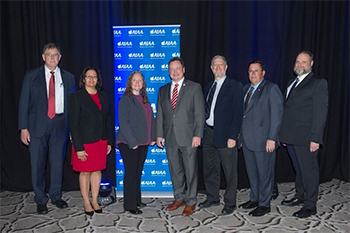
Panelists: Moderator Bill Casebeer, senior research area manager, Human Systems and Autonomy, Lockheed Martin Advanced Technology Laboratories; Julia Badger, Robonaut project manager, Autonomous Spacecraft Management Projects, NASA’s Johnson Space Center; Eileen Liu, research scientist, Human Systems and Autonomy, Lockheed Martin Advanced Technology Laboratories; Matthias Scheutz, director, Human-Robot Interaction Lab, Tufts University; Victoria Coleman, chief technology officer, Wikimedia Foundation; Michael Casale, chief science officer, STRIVR

by Michele McDonald, AIAA Communications Manager

Work in machine intelligence crosses such disciplines as neuroscience, cognitive science, cognitive architectures, theory of mind, user experience design, human behavior modeling, systems engineering and explainable artificial intelligence. But, human-machine teams hold promise in helping with space exploration, training and boosting human performance.

The thorny issue of trust is at the heart of human-machine teams, panelists discussed Jan. 11 during the “Human-Machine Teaming” session at the 2018 AIAA SciTech Forum in Kissimmee, Florida.

Our own expectations of what machines can do, the roles machines play on a team and trust in them — too much or not enough — can get in the way of teamwork, panelists said.

Trust doesn’t come automatically, said Victoria Coleman, chief technology officer of the Wikimedia Foundation.

“In reality, there is no magic bullet,” she said.

Coleman said repetition helps as does how machines arrive at decisions.

“Trust is something you establish … then it’s a cycle,” she said.

But, machine intelligence is finding a home in NASA and sports.

NASA is using smart machines that will work with crew members as the agency plans space stations for future missions, said Julia Badger, Robonaut project manager with Autonomous Spacecraft Management Projects at NASA’s Johnson Space Center. These complex space stations sometimes will work with crew members and other times will be on their own to solve problems, such as leaks, and maintain the station, she said.

Virtual reality and immersion are helping large companies train employees, said Michael Casale, chief science officer with STRIVR, a VR training company. Top-level athletes use the technology to help them improve their performance, he said.

The panelists said technical advancements are needed for humans and machines to become effective teammates. For example, humans and machines don’t speak the same language, and nuance is difficult for machines to process, explained Eileen Liu, a research scientist with Human Systems and Autonomy at Lockheed Martin Advanced Technology Laboratories

“I might say something, but I might mean something else,” she said.

Liu said humans are good at thinking creatively and solving problems on the fly but that we fail at repetitive tasks because our minds wander. She said that’s where machines excel and can help. But first, Liu said, they need to figure us out and understand how moods affect attention spans. Sensors may help machines get a handle on our state of mind, she said.

Humans and machines need to share mental models to become effective teammates, said Matthias Scheutz, director of the Human-Robot Interaction Lab at Tufts University. But, he said, we’re not there yet. Hammers and drills are tools, not teammates, and current technology could be described the same way, Scheutz said.

He said we expect if a machine can pick up a square, it can pick up another shape but that that’s simply not the case.

“The kind of quick inference we expect of people, we will expect of machines,” Scheutz said.

People want robots to be adaptive and better than they are, Badger said.

“My (son) was 9 months old, and he got better at grasping things than my robot did at the time. My robot should be better because he’s 8 years old,” she said, laughing.
Video

All 2018 AIAA SciTech Forum Videos

Tech Challenges of On-Demand Mobility

Panelists: Moderator Michael Patterson, aerospace technologist, NASA’s Langley Research Center; Danette Allen, senior technologist of intelligent flight systems, NASA’s Langley Research Systems; Brian J. German, Langley associate professor, Georgia Institute of Technology; Andrew R. Gibson, president, Empirical Systems Aerospace Inc.; Ken Goodrich, senior research engineer, NASA’s Langley Research Center; Stephen Rizzi, senior researcher for aeroacoustics, NASA’s Langley Research Center

By Tom Risen, Aerospace America staff reporter (2017-2018)

Technologies that led to the boom in consumer drones are making it possible for companies to build a new generation of electric vertical takeoff and landing craft, or eVTOLs, but businesses aspiring to on-demand mobility face new obstacles. Engineers and NASA technologists detailed these challenges Jan. 10 during the “On-Demand Mobility — Enabling Technologies and Capabilities” panel at the 2018 AIAA SciTech Forum in Kissimmee, Florida.

Distributed electric propulsion, propeller technologies and autonomous flight software are among the technologies pioneered by consumer drones being used in aircraft designs that can expand conventional on-demand flight and enable new air cargo delivery and sky taxi services.

NASA held a series of workshops two years ago that came up with a prioritized list of 10 barriers to on-demand mobility, the foremost being ease of certification, affordability and safety, said Michael Patterson, an aerospace technologist with NASA’s Langley Research Center.

“If one of these doesn’t get addressed, the whole thing probably doesn’t happen,” Patterson said of the list of 10 priorities, which includes community noise reduction for the aircraft.

Public acceptance will also depend on certification and safety concerns about autonomous flight software, said Danette Allen, senior technologist of intelligent flight systems at NASA’s Langley Research Systems in Virginia. The public will also have to clear up misconceptions about autonomous flight, Allen said, explaining that “unmanned” is not the same as “autonomous,” because aircraft are not autonomous if humans are still waiting at monitors ready to intervene.

Designing an electric aircraft around the electric propulsion source can give manufacturers a head start on addressing safety and efficiency, said Andrew R. Gibson, president of California-based Empirical Systems Aerospace Inc. Gibson’s company is the prime contractor for NASA’s X-57 plane, which aims to be quieter and five times more energy-efficient during high-altitude cruising than a combustion-driven plane of the same size.

Ken Goodrich, a senior research engineer at Langley, said there has been “a tipping point the last two or three years” at the agency, which is more interested than ever in on-demand mobility in part because of progress in driverless cars.

“As somebody who has had a passion for small aircraft going back to when I first started at NASA several decades back, the idea of using advanced automation to make airplanes simple to fly has always faced a healthy amount of skepticism,” Goodrich said.

Video

All 2018 AIAA SciTech Forum Videos

Mainstreaming Urban Air Mobility

Panelists: Moderator Bruce Holmes, vice president for digital aviation, SmartSky Networks LLC; Carl Dietrich, chief technology officer and co-founder, Terrafugia; Mark Moore, director of engineering, Uber Elevate; Mark Cousin, senior vice president of flight demonstrators, Airbus; Brian Yutko, vice president of research and development, Aurora Flight Sciences

By Tom Risen, Aerospace America staff reporter (2017-2018)

Companies are building and testing electric vertical takeoff and landing aircraft, or eVTOLs, to ferry people above car traffic, but they need to be safe, affordable and energy-efficient to become part of a daily commute. Entrepreneurs and engineers detailed how their companies are tackling these challenges Jan. 10 during the “Dude, Where’s My Flying Car” panel at the 2018 AIAA SciTech Forum in Kissimmee, Florida.

To build an urban air mobility ecosystem for these aircraft, vehicle manufacturers will have to coordinate with numerous types of organizations, including real estate providers to create landing pads known as skyports, said Mark Moore, director of engineering at California-based Uber Elevate.

“We will never build a vehicle, but we want to make sure that our partners who are building vehicles are successful and that these aircraft are as community-friendly as possible,” Moore said, explaining Uber Elevate’s partnership with manufacturers and regulatory agencies to clear the way for Uber to provide on-demand flight through a mobile app. Some of the companies partnering with Uber have not publicly released their aircraft concepts, so Moore unveiled a “common reference model” that illustrates some of the challenges these electric aircraft will face, including battery energy density and noise pollution.

“The batteries are almost there, because the longest distance we need to travel in between skyports is only 45 miles,” Moore said.

Noise and expense are two of the major reasons helicopters are not more widely used for urban transport, and eVTOLs will have to improve upon both to gain public acceptance, said Mark Cousin, senior vice president of flight demonstrators at Airbus.

Cousin predicted there would be “a multitude” of aircraft designs for the new generation of urban air mobility, referring to the numerous types of cars on the road. Airbus holds true to that example: a prototype of its CityAirbus air taxi will test fly at the end of 2018, he said. A full-scale demonstrator of the tandem tilt-wing Vahana aircraft by Airbus’ Silicon Valley arm, A3 [pronounced “A cubed”], “will fly within the next month,” he said.

Video

All 2018 AIAA SciTech Forum Videos

Crowdsourcing the Future of Aerospace

Panelists: Moderator Jenn Gustetic, program executive of small business innovation research, NASA; Jason Crusan, director, Advanced Exploration Systems Division, NASA; Dustin Fraze, program manager, Information Innovation Office, DARPA; Monsi Roman, program manager, Centennial Challenges, NASA; Chris Frangione, open innovation consultant; Zoe Szajnfarber, associate professor of engineering management and systems engineering and space policy, George Washington University

By Tom Risen, Aerospace America staff reporter (2017-2018)

Organizations like NASA, DARPA and even intelligence agencies are increasingly challenging the professional community or general public to solve technical problems for them — a process known as crowdsourcing. Experts on the Jan. 9 panel “Prizes & Challenges — How Crowdsourcing Can Help Solve Technology Gaps” at the 2018 AIAA SciTech Forum in Kissimmee, Florida, described what people need to know when creating or applying for a contest to achieve an out-of-reach scientific goal in aerospace engineering.

The growth of crowdsourcing has led to the creation of several toolkits, such as citizenscience.gov, that help interested parties design a challenge. DARPA has awarded prizes for applicants who helped advance autonomous car research, while NASA’s 3-D Printed Habitat Challenge seeks additive construction technology to help build sustainable housing on missions to Mars.

“Challenges and prizes work best when you define a problem,” said Chris Frangione, a consultant who was formerly the vice president of prize development and execution at the XPRIZE Foundation. “Once you ask for a specific solution, then you hinder innovation.”

A key factor in planning a challenge is what kind of incentives to offer people to solve a seemingly impossible problem, but some people pursue such challenges for the glory of the achievement.

“The No. 1 feedback we hear from our participants is ‘I wanted to solve this because it was hard,’” said Monsi Roman, the program manager of Centennial Challenges at NASA’s Space Technology Mission Directorate.

The compensation should match the cost of solving the problem to make sure qualified people devote their spare time to completing the challenge, Frangione said.

“Prize design is the most critical element,” he said. “The best thing about prizes is that you get what you incentivize. The worst thing about prizes is that you get what you incentivize.”

To complement or make up for the absence of a large cash reward, an organizer can offer full-time jobs at their company if the resulting career would be prestigious enough. Organizers of challenges will sometimes reserve all rights to the intellectual property of the technology created to for the competition.

Applicants should read the terms and conditions of a challenge, including the intellectual property details, to make sure the challenge would be worth their time and effort, said Jenn Gustetic, program executive of small business innovation research at NASA.

Video

All 2018 AIAA SciTech Forum Videos

Astronaut John Young Remembered at AIAA SciTech

During a plenary session Jan. 9 at the 2018 AIAA SciTech Forum in Kissimmee, Florida, the Institute honored retired U.S. Navy Capt. John Young, who died Jan. 5 at age 87, with a moment of silence.

“Capt. Young was an American hero — a true astronaut’s astronaut who had an incredible career and lived a life full of ‘firsts’ and ‘onlys,’” said retired U.S. Air Force Col. Pamela A. Melroy, a former astronaut and general chair of the 2018 AIAA SciTech Forum. “To say that Young flourished at NASA is an understatement. He was the only astronaut to command three different kinds of spacecraft: Gemini, Apollo, and the Shuttle; was the first to fly into space six times; visited the moon twice; and had a career spanning 42 years — the longest of any U.S. astronaut. His accomplishments are the stuff of lore.”

Click here to read the full statement.

Digital Disruption in Aerospace

Panelists: Moderator Darryll J. Pines, dean of the A. James Clark School of Engineering, University of Maryland; Andreas Bernhard, chief engineer, CH-53K, Sikorsky Aircraft Corp.; LaNetra Tate, program executive, Space Technology Mission Directorate, NASA; Jack O’Banion, vice president, Lockheed Martin; Brendan Iribe, co-founder, Oculus

by Tom Risen, Aerospace America staff reporter (2017-2018)

Digital innovation that changed daily life with smartphones and cloud computing is now breaking technical barriers in space and aviation, technologists explained Jan. 8 during the “Digital Transformations Disrupting Aerospace Business Models” panel at the 2018 AIAA SciTech Forum in Kissimmee, Florida.

The design process for aircraft is one of the main digital disruptions in the aerospace sector. The CH-53K King Stallion helicopter that Sikorsky is developing for the U.S. Marine Corps is the Lockheed Martin subsidiary’s first production aircraft built with a completely digital, paperless design, said Andreas Bernhard, the helicopter’s chief engineer at Sikorsky. Looking ahead to the 2020s, Bernhardpredicted“our most profitable product is no longer going to be the Black Hawk, but the CH-53K.” New technologies on the CH-53K also include composite rotor blades that he said “generate enough lift to carry an empty Black Hawk,” a transmission with improved power density than previous generation Sikorsky helicopters, and digital engine controls in the cockpit.

Digital assistants that are becoming more widely used on smartphones also have great potential to guide aerospace engineers. A “Siri for designers” akin to the Apple digital assistant could give real-time feedback on the effect of different options, including materials, said Jack O’Banion, vice president of strategy and customer requirements with Advanced Development Programs at Lockheed Martin.

“There are optimizing routines out there now, but if you’re not careful with the human too far removed from the design loop, you could walk through design choices that you may have preferred to make,” O’Banion said.

NASA is also keeping flexibility in mind when designing its autonomous technology. The semi-autonomous, free-flying robot Astrobee that NASA’s Ames Research Center is developing to assist International Space Station astronauts in tasks like inventory will free up valuable time on the station. The disruptive feature of it, however, is that it can be upgraded with code for scientific tests and improvements from people outside of NASA, said LaNetra Tate, program executive with NASA’s Space Technology Mission Directorate.

Virtual reality and augmented reality also have the potential to change aerospace training, design, communication and visualization. Brendan Iribe, co-founder of California-based virtual reality hardware developer Oculus, said the world is at the beginning of a “virtual age,” with the growing availability of devices, including the Oculus Rift headset. In decades to come, he said, rovers on Mars could scan their surroundings to give people a chance at interacting with the red planet in a virtual simulation.

Video

All 2018 AIAA SciTech Forum Videos

Big Data’s Power Starting to Reach Potential

Panelists: Moderator Joseph Morrison, associate project manager, Transformational Tools and Technologies, NASA’s Langley Research Center; Jandria Alexander, principal, Booz Allen Hamilton Inc.; David Keyes, director, Extreme Computing Research Center, King Abdullah University of Science & Technology; Pamela Kobryn, principal aerospace engineer, Structures Technology Branch, Aerospace Vehicles Division, Aerospace Systems Directorate, Air Force Research Laboratory; Dimitri Mavris, director, Aerospace Systems Design Laboratory, Georgia Institute of Technology; Mark Valentine, Department of Defense Strategic Initiatives Group, Microsoft

by Michele McDonald, AIAA Communications Manager

Data-Data-Everywhere-Pane-SciTech2018-350
Participants in the discussion, “Data, Data Everywhere…the Power & Potential,” Jan. 9 at the 2018 Science and Technology Forum in Kissimmee, Fla.

The aerospace industry can be a leader in how best to apply big data to real-world critical missions, speakers discussed in a series of presentations Jan. 9 during the “Data, Data Everywhere … the Power & Potential” session at the 2018 AIAA SciTech Forum in Kissimmee, Florida

The influx of digital data is changing everything from improving how we buy cars to space exploration. For example, Pamela Kobryn, a principal aerospace engineer with the Aerospace Systems Directorate at the Air Force Research Laboratory, said digital twins — digital counterparts to physical things — could change how we buy and maintain cars.

Your digital twin would know your driving habits, including the routes you take and how much you hit the brakes, she said, explaining the information would be “personalized to how you are going to drive that vehicle.”

Kobryn explained automakers would have simulations to match driving habits and requirements with vehicles and that you’d know how your new car would handle, how much gas it would use and future maintenance costs.

“Now imagine if that simulation capability was free, easy to use and access, and readily available — it would be pretty cool,” she said.

But the journey doesn’t stop there. Your new car would have its digital counterpart continually updated about maintenance needs and could predict possible breakdowns during trips, Korbyn said, adding that when it’s time to buy a new car, the digital twin could inform the timing of that decision, too.

The same concept of digital twins can be applied to aircraft, spacecraft and other complex systems, Korbyn said.

Big data also is changing digital assistants, said Mark Valentine, with the Department of Defense Strategic Initiatives Group at Microsoft.

“There are millions of decision points, and the data is overwhelming, so it sounds to me like we need some help,” he said.

And Valentine said we’re already familiar with the perfect digital assistant. 

“I think George Lucas gave us the best blueprint for a digital assistant back in 1975, and his name was R2-D2,” Valentine said. “R2-D2 could do almost everything.”

He said future assistants will take action.

“Much like Luke (Skywalker) would tell R2 to go do something and R2 would go do it,” Valentine said.

Digital assistants are drawing data from sensors, context and our actions.

“Our assistants now know me — they know us — our preferences,” Valentine said. “And not just what we say we like, but they learn from our actions. There’s a complete difference between what we say we like and what we actually like. Digital assistants now know my context because of the proliferation of sensors … now the digital assistant can anticipate what I need to know in the future.”

This deep knowledge of our lives leaves us vulnerable when paired with cybersecurity concerns and questioning if we can trust the data, said Jandria Alexander, principal at Booz Allen Hamilton.

She said computer systems constantly are under attack, and the attackers don’t have to be sophisticated to cause damage. Legacy systems are easy targets, Alexander said, adding that newer complex systems are connected to these vulnerable systems.

No system is safe from attack, she said, explaining that the new approach is to be resilient and continue to operate through attacks. Alexander said big data is giving us some detailed answers about how to build resiliency against cyberattacks into the systems.

But planning for cybersecurity becomes thornier when it takes decades to build a spacecraft while technology keeps evolving.

“What we’re fielding has to be sound and has to protect from threats we can’t even predict,” Alexander said. “We don’t even know what those threats are. But the good news is if we build these in an architecturally sound fashion, we can actually prevent classes of attacks.”

Video

All 2018 AIAA SciTech Forum Videos

Digital Engineering Transforming Manufacturing

Panelists: Moderator Pamela Kobryn, principal aerospace engineer, Structures Technology Branch, Aerospace Vehicles Division, Aerospace Systems Directorate, Air Force Research Laboratory; Brenchley Boden, chief technology officer, Digital Manufacturing and Design Innovation Institute, and senior industrial engineer, AFRL; Michael W. Grieves, executive director, Center for Advanced Manufacturing and Innovative Design, Florida Institute of Technology; Brunon “Dave” Kepczynski, chief information officer, GE Global Research, and engineering product leader, GE Digital; John H. Vickers, principal technologist, Space Technology Mission Directorate, NASA; Chuck Ward, chief, Manufacturing and Industrial Technologies Division, Materials and Manufacturing Directorate, AFRL; Caroline Gorski, global partnership director for digital, Rolls-Royce

by Michele McDonald, AIAA Communications Manager

Dawn-of-Digital-Engineering-Panel-SciTech2018
Participants in the Jan. 8 discussion “The Dawn of Digital Engineering” at the 2018 Science and Technology Forum in Kissimmee, Fla.

In the dawn of digital engineering, the challenges are daunting, but the rewards extend far beyond manufacturing, panelists said Jan. 8 during the “The Dawn of Digital Engineering?” forum at the 2018 AIAA SciTech Forum in Kissimmee, Florida.

The panelists said digital engineering could boost efficiency, slash costs, increase agility and reveal problems before production begins. However, they pointed out some challenges, including overcoming cultural biases, navigating through massive amounts of data and figuring out how to retain and make accessible digitized data into the future.

Digital twins and models are disrupting the status quo, though, they said. For example, a digital twin of an airplane can move through its physical counterpart’s entire lifecycle from the design stage to manufacturing to service and support, said Chuck Ward, with the Air Force Research Laboratory’s Materials and Manufacturing Directorate.

“You now have a flying laboratory,” Ward said.

Beyond digital twin prototypes, there are digital twin aggregates, said Michael W. Grieves, executive director of the Center for Advanced Manufacturing and Innovative Design at Florida Institute of Technology. He said these aggregates can help engineers predict when equipment needs to be replaced and that it’s all about prognostics and learning so “later versions of a product don’t have to go through the same learning curves as earlier versions.”

Digital twins and digital engineering may help NASA reach Mars and beyond while cutting costs and saving time, said John H. Vickers, principal technologist with NASA’s Space Technology Mission Directorate. The traditional building block approach can take decades and tens of millions of dollars to get equipment into space.

The Department of Defense is shifting to a digital engineering ecosystem from initial research and development all the way to maintenance and eventually retirement, said Pam Kobryn, with the Aerospace Systems Directorate at AFRL. She said the DOD is working with traditional modeling and simulation while leveraging high-performance computing and software networking.

“The dawn of digital engineering — the questions are all around the unknowns,” Korbyn said, adding that the DOD is looking at the portability of the models, value across the lifecycle, how to speed up the pace of delivery and how to provide simple support to complex problems.

And then terabytes of data must be managed. For that, engineers are borrowing from the field of biology and bundling information into packets, similar to the DNA code, Ward said.

“We need to figure out how to learn from all that data,” said Brenchley Boden, chief technology officer of the Digital Manufacturing and Design Innovation Institute, and senior industrial engineer at AFRL.

The factory floor needs to become more intelligent, he said, adding that sensors could be a solution for older equipment.

In addition, the industry needs to move to an ecosystem approach in which all the functions can be seen at the same time, away from its current focus on parts and subsystem levels, said Brunon “Dave” Kepczynski, chief information officer at GE Global Research and engineering product leader with GE Digital.

Building such an ecosystem means companies need to think beyond their own walls and collaborate with players from across systems, said Caroline Gorski, global partnership director for digital at Rolls-Royce. Industrial “internet of things,” artificial intelligence, advance analytics and blockchain are figuring into the new digital engineering ecosystem.

But, the panelists said, the next generation of engineers may hold the answer.

“They come digitally ready,” Vickers said.

Video

All 2018 AIAA SciTech Forum Videos

Aerospace Industry Should Lead the Fourth Industrial Revolution

Speaker: Naguib Attia, vice president, Global University Programs, IBM

by Lawrence Garrett, AIAA Web Editor

To bring to fruition the full benefits of the digital enterprise business model, a number of challenges still need to be met and there is no sector better-suited for leading this charge than aerospace, said Naguib Attia, vice president of Global University Programs at IBM, Jan. 8 during the “Digital Enterprise Business Models — Their Impact on the Aerospace Industry” session at the 2018 AIAA SciTech Forum in Kissimmee, Florida.

The aerospace and defense sector has traditionally led the world with technological ideas, Attia said, citing the automotive industry as one industry that followed aerospace’s lead. He said the industry must work closely with academia to bring about new ideas.

“Aerospace and defense is made up of complex environments with multiple interconnected groups that must work together,” Attia said.

With revolutionary technologies like the “internet of things,” blockchain, the cloud, 3-D printing and quantum computing, eventually there will be one big ecosystem, Attia explained, warning that industry and academia will need to change their way of thinking.

He cited three key challenges, including innovation, recruiting talent, and transforming the enterprise process and systems to better enable competitiveness. These challenges have created an environment in which data has become the core work for aerospace and defense, Attia said.

“Everything is attached; everything is connected; everything is talking to each other,” he said.

Attia shared his vision of a future single system that will be capable of pinpointing many of today’s common issues while also fixing them and improving quality control.

He noted the primary challenge for academia is making the internet of things not just read-only data to be returned for later analysis, but also “a cognitive system” that helps determine which data to select and which to work with. The debate is between how much technology to put at the endpoint, he said, and “how much of that technology can have some cognitive component.”

Attia advised that today’s research should be focused on what kind of technology and intelligent systems are needed and whether that technology should be implemented at the end endpoint, in the cloud or on a server.

He said aerospace and defense can lead in these areas.

“I think aerospace and defense can come with an optimum solution,” he said.

Attia also said that using sensors and cognitive internet of things in production tooling is key.

“You cannot just cut an engine part; you cannot just make things,” he noted, adding the tooling has to be precisely calibrated to perfection.

“You are working with an industry that cannot accept error,” Attia pointed out. “That’s the beauty about the aerospace industry. There’s no room for error because it is fatal; a plane is not a car.”

Attia suggested sensors and cognitive internet of things can help reduce the risk and said that cognitive internet of things has already broken one barrier — blockchain technology. Attia predicted that blockchain will impact the aerospace industry more than other industries.

Noting the financial sector has already created its own blockchain system, Attia said he thinks the aerospace and defense industry should come up with its own system, with defense on one side and civil on the other.

He said if the system comes to fruition, transparency would exist throughout the entire lifecycle of a product, reducing risk at every stage as well as saving time.

Attia also said quantum computing will become more secure and will serve as “the backbone for the digital transformation of the next 10 years.”

Video

All 2018 AIAA SciTech Forum Videos