Spaceflight Now reports, “SpaceX sent its latest batch of Starlink satellites into low Earth orbit Monday late afternoon. Among the 21 V2 Mini satellites were 13 that feature Direct to Cell capabilities. Liftoff of the Falcon 9 rocket on the Starlink 12-7 mission from pad 40 at Cape Canaveral Space Force Station happened at 5:05 p.m. EST.” Full Story (Spaceflight Now)
Video
SpaceX Falcon 9 launches 21 Starlink satellites from from Cape Canaveral (Launch at 0:59:42 mark)
(Spaceflight Now; YouTube)
SPACE reports, “Spacecraft powered by electric propulsion could soon be better protected against their own exhaust, thanks to new supercomputer simulations. Electric propulsion is a more efficient alternative to traditional chemical rockets, and it’s being increasingly used on space missions, starting off with prototypes on NASA’s Deep Space 1 and the European Space Agency’s SMART-1 in 1998 and 2003, respectively, and subsequently finding use on flagship science missions such as NASA’s Dawn and Psyche missions to the asteroid belt. There are even plans to use electric propulsion on NASA’s Lunar Gateway space station.” Full Story (SPACE)
Spaceflight Now reports, “SpaceX launched its latest batch of Starlink satellites from California during a Falcon 9 flight Friday morning. Liftoff of the Starlink 11-6 mission from Space Launch Complex 4 East (SLC-4E) happened at 6:07 a.m. PST (9:07 a.m. EST, 1407 UTC).” Full Story (Spaceflight Now)
Video
SpaceX Falcon 9 rocket launches 23 Starlink satellites from Vandenberg (Launch at 18:59 mark)
(NASASpaceflight; YouTube)
Guy Norris at Aviation Week reports, “Hydrogen fuel may offer attractive pathways toward the goal of zero carbon emissions, but turning that vision into a practical propulsion system is another matter. Now Pratt & Whitney thinks it may have taken the first steps along that path with the Hydrogen Steam-Injected, Intercooled Turbine Engine (HySIITE) concept—a novel hybrid engine configuration that combines the advantages of the fuel’s cryogenic properties with the thermodynamic benefits of steam injection. Pratt & Whitney has unveiled details of the concept, which has been studied under a two-year $3.8 million U.S. Energy Department Advanced Research Projects Agency–Energy (ARPA-E) effort. While Pratt acknowledges the cycle is complex and requires more study, it is encouraged by the results, which show potential for as much as 35% lower energy use compared with current state-of-the-art engines.” Full Story (Aviation Week)
Aviation24.be reports, “The world is on the verge of witnessing a historic moment in aviation. Boom Supersonic, the company pioneering the return of commercial supersonic travel, is preparing for the maiden supersonic flight of its XB-1 demonstrator. After a rigorous program of 11 successful test flights at increasing speeds, XB-1 is poised to break the sound barrier. This groundbreaking event will be livestreamed globally, allowing the public to witness this pivotal moment in aviation history. The livestream is scheduled for January 28, 2025, at 06:45 PST/09:45 EST/14:45 GMT.” Full Story (Aviation24.be)
Aviation Week reports SpaceX’s “effort to demonstrate payload deployment, land its upper stage and potentially achieve spaceship-to-spaceship fuel transfer this year had an inauspicious start when the Starship system suffered a setback during the Jan. 16 flight. Minutes after launch, the Block 2 upper stage broke up when a fire developed in the aft section.” Full Story (Aviation Week)
Video
A SpaceX Starship rocket exploded shortly after launching on its seventh test flight.
(Brut India; YouTube)
Aerotime reports, “Lockheed Martin has been awarded a $270 million contract by the US Air Force to integrate next-generation infrared defensive sensors on the F-22 Raptor. Under the agreement, the F-22 will be equipped with a distributed set of embedded TacIRST sensors, collectively known as the Infrared Defensive System (IRDS). These sensors are designed to bolster the Raptor’s ability to detect, track, and counter adversarial threats in the infrared spectrum.” Full Story (Aerotime)
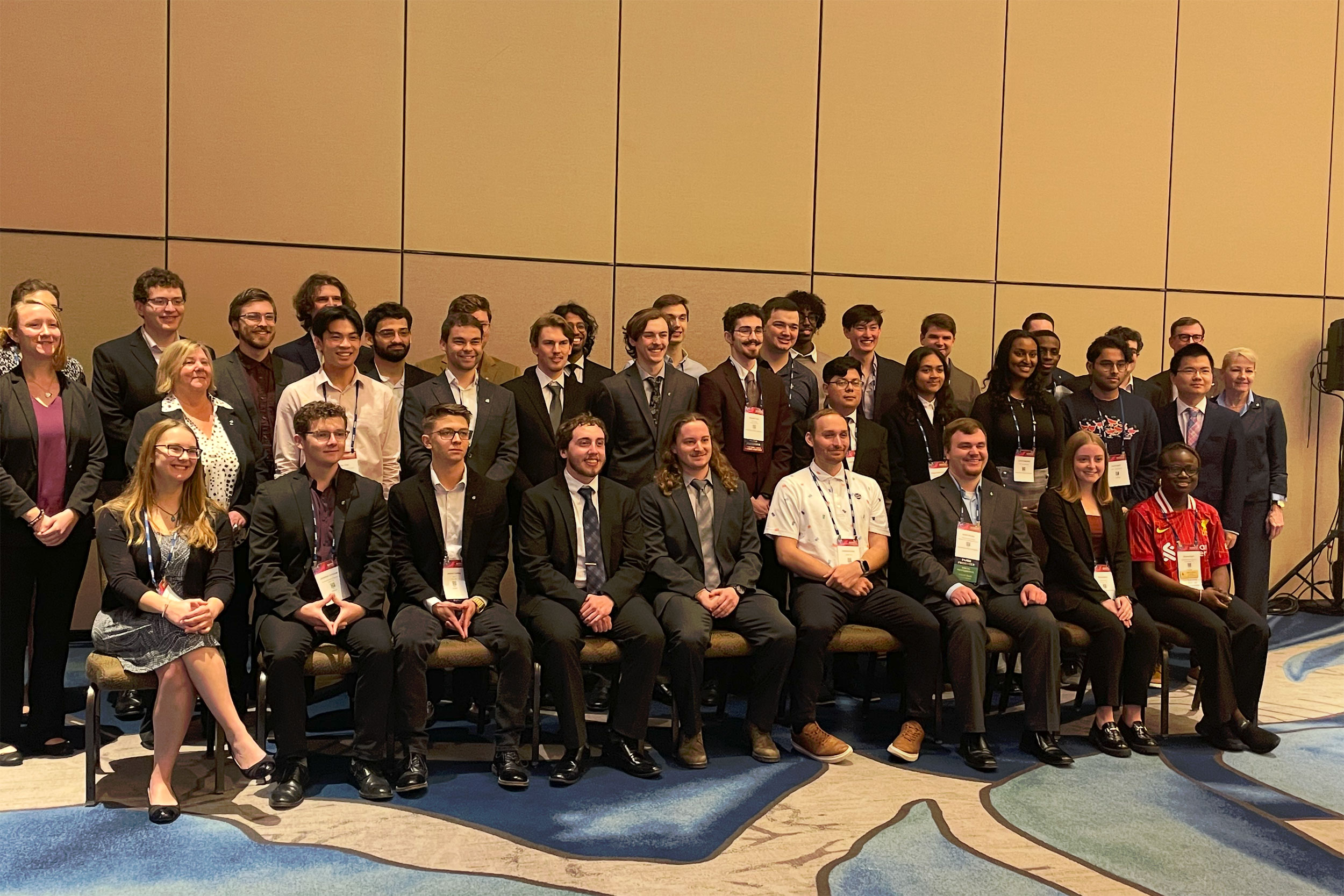
January 22, 2025 – Reston, Va. – The American Institute of Aeronautics and Astronautics (AIAA) is pleased to announce the 2025 International Student Conference winners in partnership with the AIAA Foundation. During the 2025 AIAA SciTech Forum, 20 technical paper first-place finalists from all seven 2024 AIAA Regional Student Conferences and the PEGASUS – Europe Conference presented their research papers related to aeronautics and astronautics.
“Congratulations to these exceptional students – our future leaders in aerospace. These bright minds are today’s up-and-coming innovators. Their fresh perspectives and critical thinking are working to solve current technical challenges. They will help shape the aerospace landscape for decades to come,” said Laura McGill, chair, AIAA Foundation. “The AIAA Foundation takes great pride in nurturing their development through initiatives like the International Student Conference.”
This event is invitation-only, contained within the annual AIAA SciTech Forum, where first-place winners from each of the previous year’s AIAA Regional Student Conferences present their winning papers. They are judged by a panel of AIAA professional members in the undergraduate, master’s, and team categories. AIAA Foundation awards a $1,000 cash prize to each category’s first-place winner. All participants’ papers are published as part of the AIAA SciTech Forum proceedings and become part of the enduring aerospace industry technical archive found in AIAA’s Aerospace Research Central (ARC).
Undergraduate Category: 1st Place: “Experimental Investigation of the Impact of Propeller Configuration, Motor Noise, and Sound Reflection on Sound Pressure Level” by Olivia Hilburn, United States Air Force Academy
Master’s Category 1st Place: “Performance Characteristics of a Low-Cost Self-Contained Pressure Data Acquisition System” by Nathan Eller, California State Polytechnic State University, San Luis Obispo
Team Category 1st Place: “Lessons Learned from the Launch of a Student-Built LOX/Jet-A Sounding Rocket” by Callum MacDonald, Rithvik Nagarajan, Ethan Heyns, Braden Anderson, Michael Krause, Varun Natarajan, Anthony Otlowski, and Tristan Terry, Georgia Institute of Technology
Media Contact: Rebecca Gray, [email protected], 804.397.5270 cell Click images to see larger versions.
About AIAA
The American Institute of Aeronautics and Astronautics (AIAA) is the world’s largest aerospace technical society. With nearly 30,000 individual members from 91 countries, and 100 corporate members, AIAA brings together industry, academia, and government to advance engineering and science in aviation, space, and defense. For more information, visit aiaa.org, and follow AIAA on Twitter, Facebook, LinkedIn, and Instagram.
Aviation Week reports, “Rolls-Royce says it has competed certification testing of a major upgrade to the Trent 1000 to address durability problems and is now looking to secure the delayed certification of the so-called Durability Enhancement.” Full Story (Aviation Week)
Via Satellite reports, “SpaceX’s dramatic Starship test on Thursday afternoon has triggered a Federal Aviation Administration (FAA) mishap investigation after debris from the test impacted air travel and may have damaged public property in Turks and Caicos. SpaceX launched the seventh flight test for its massive Starship rocket on Jan. 16, testing extensive upgrades to the vehicle for the first time. After a successful liftoff, stage separation, and recapturing the booster on land, SpaceX lost communication with the ship, which broke apart over the Caribbean.” Full Story (Via Satellite)