
SPACE reports, “Blue Origin launched its 15th space tourism flight” yesterday (Oct. 8), “sending six people on a brief trip to the final frontier, including a mystery passenger who only revealed his identity after the flight. The company’s New Shepard vehicle lifted off from Blue Origin’s West Texas launch site [Wednesday] at 9:40 a.m. EDT (1340 GMT; 8:40 a.m. local Texas time), kicking off a suborbital flight known as NS-36.”
Full Story (SPACE)
Tag: Astronautics
AIAA Updates Book Proposal Process
FROM AIAA
Book and eBook proposals are now accepted through AIAA ScholarOne Books Portal—the same trusted platform many authors already use for AIAA journals. For more than 50 years, AIAA books have captured the knowledge and expertise of leaders in our industry. With our updated portal, we’re making it simpler than ever to contribute to this legacy of advancing aerospace research and innovation.
AIAA Announces Winners of Prestigious Zarem Graduate Student Awards for Distinguished Achievement in Aeronautics and Astronautics
FOR IMMEDIATE RELEASE
October 8, 2025 – Reston, Va. – AIAA is pleased to announce the winners of the Zarem Graduate Student Award for Distinguished Achievement:
- Patrick Eid, Auburn University, won the astronautics award for his paper, “Evolution of the Bidirectional Vortex in a Capped Ellipsoidal Cyclonic Rocket Engine.” Eid presented his paper at the 76th International Astronautical Congress (IAC) in Sydney, Australia, 29 September–3 October 2025.
- Luke Busse, University of Cincinnati, won the aeronautics award for his paper, “Multi-Sensor Based Adaptive Fusion Scheme for Position Estimation of Multirotor UAV Systems in GPS-Denied Environments.” Busse will present his paper at the 35th Congress of the International Council of the Aeronautical Sciences (ICAS) in Sydney, Australia, 13–18 September 2026.
The winners will receive their awards at AIAA SciTech Forum 2026, Orlando, Florida, 12–16 January 2026. This award was established by AIAA Honorary Fellow Abe Zarem, founder and managing director of Frontier Associates, to annually recognize graduate students in aeronautics and astronautics who have demonstrated outstanding scholarship in their field.
Patrick Eid, Auburn University, Astronautics Award
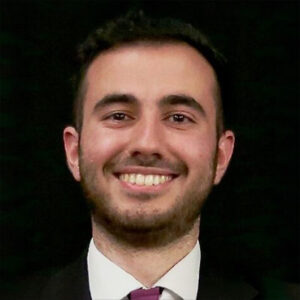 Patrick Eid is a Graduate Teaching and Research Assistant in the Department of Aerospace Engineering at Auburn University. He is a member of the Advanced Propulsion Research Lab directed by Professor Joseph Majdalani. Eid holds a Bachelor of Engineering in Mechanical Engineering from Notre Dame University (NDU). He has distinguished himself through leadership roles as Secretary of the ASME Student Chapter, Treasurer of the Astronomy Club, and Deputy Secretary General of the Model United Nations Program. His prior accolades include global honors at NASA’s International Space Apps Challenge and top distinctions in the ASME EFx Oral Presentation Competition at NDU and the 2025 AIAA Region II Student Conference.
Eid’s faculty advisor, Joseph Majdalani, is the Francis Chair of Excellence in Aerospace Engineering at Auburn University. An AIAA Fellow, he is recognized for pioneering work in acoustic instability and cyclonic-engine technology. With over 350 publications and 21,000 citations, he ranks in the top 0.8% of aerospace researchers globally. His breakthroughs include new cyclonic, vorticoacoustic, asymptotic, computational, similarity, stability, boundary-layer, and high-speed flow formulations. He is known for coauthoring Viscous Fluid Flow with Frank White while cracking the Pohlhausen paradox on its centennial anniversary. Besides 27 Best Papers, his main accolades include the Walker Teaching, Spencer Mentorship, Wyld Propulsion, Von Kármán Lectureship, Research Excellence, Abe Zarem Educator (4 times), Book Author, Outstanding Graduate Mentor, Leland Atwood Educator, Sustained Service, Foundation Faculty Advisor, Dannenberg Educator, Hap Arnold, Ralph Teetor Educator, Marquette Outstanding Teacher (twice), and CAREER Awards.
Luke Busse, University of Cincinnati, Aeronautics Award
 Luke Busse received Bachelor of Science degrees in Mechanical Engineering Technology and Engineering Management from Bluefield State University, WV, in 2022, and a Master of Science in Mechanical Engineering from the University of Cincinnati in 2025. He is currently a doctoral student in the Department of Mechanical Engineering at the University of Cincinnati under the supervision of Dr. Manish Kumar. Busse’s research interests include autonomous navigation and control of uncrewed aerial vehicles, machine learning, and multi-sensor fusion. His research is focused on hardware and software development of UAV systems capable of navigating in previously unknown environments where GPS is unreliable or unavailable while processing real-time data for mission-critical applications to achieve autonomous operation.
His faculty advisor, Manish Kumar, received his bachelor’s degree in mechanical engineering from the Indian Institute of Technology, Kharagpur, India, and his M.S. and Ph.D. degrees in Mechanical Engineering from Duke University. After serving as a postdoctoral researcher at Duke University, the U.S. Army Research Office, and University of Pennsylvania, he started his career as a faculty member at University of Cincinnati (UC) in the Department of Mechanical and Materials Engineering where he currently serves as a Professor and the Graduate Program Director. At UC, he directs Cooperative Distributed Systems (CDS) Laboratory, co-directs Industry 4.0/5.0 Institute, and co-directs Applied Autonomy Lab. His research interests include unmanned aerial vehicles, robotics, decision making and control in complex systems, AI, multi-sensor data fusion, swarm systems, and multiple robot control.
For more information on the Abe M. Zarem Graduate Awards for Distinguished Achievement, contact Merridith Kauten, at [email protected] or 703-264-7503.
Media Contact: Rebecca Gray, [email protected], 804-397-5270 cell
About AIAA
The American Institute of Aeronautics and Astronautics (AIAA) is the world’s largest aerospace technical society. With nearly 30,000 individual members from 91 countries, and 100 corporate members, AIAA brings together industry, academia, and government to advance engineering and science in aviation, space, and defense. For more information, visit www.aiaa.org, and follow AIAA on LinkedIn, Instagram, X/Twitter, and Facebook.
Blue Origin to Build Payload Processing Facility at Cape Canaveral SFS
Aviation Week reports, “Blue Origin will build a new payload processing facility at Cape Canaveral SFS, Florida, under a U.S. Space Force contract announced Oct. 7. The service’s Space Systems Command (SSC) recently awarded the space technology company a $78.25 million contract under its National Security Space Launch (NSSL) Space Vehicle Processing Commercial Solutions Opening contract, to help expand the Eastern Range’s rocket processing capacity by 2028, the command said in a release.”
Full Story (Aviation Week)
FCC Declares October as ‘Space Month’ in Effort to Accelerate Satellite Regulatory Reforms
Space News reports, “FCC Chairman Brendan Carr vowed Oct. 6 to accelerate satellite regulatory reforms, declaring October as ‘Space Month’ at the U.S. regulator to overhaul licensing and spectrum rules amid mounting competition from China.”
Full Story (Space News)
Space Force Announces SpaceX, ULA Assigned to First Set of Key Launches Beyond FY27
Breaking Defense reports, “The Space Force announced today that it has assigned the first seven future launches under its National Security Space Launch Program (NSSL) program for critical missions: five to SpaceX and two to United Launch Alliance (ULA). NSSL Phase 3 Lane 2 launches carry high-value, must-go payloads and/or those headed to orbits that are more difficult to achieve. The Space Force is using firm-fixed price, indefinite-delivery contracts for these types of launches.”
Full Story (Breaking Defense)
Starlab Space Partners with Saber Astronautics for Payload Services Aboard Starlab’s Commercial Space Station
Military Aerospace reports, “Starlab Space LLC in Houston announced a strategic partnership with Saber Astronautics in Adelaide, Australia, establishing the company as both a channel and implementation partner for payload services aboard the Starlab commercial space station. Under the agreement, Saber Astronautics will play a dual role: driving business development by engaging new customers for Starlab’s microgravity platform and providing technical execution services, including feasibility assessments, hardware integration, and in-orbit operational support.”
Full Story (Military Aerospace)
ESA Sets Record with Deep-space Laser Link to NASA’s Psyche Probe Using Altechna Optics
Military Aerospace reports, “The European Space Agency (ESA) has completed a deep-space optical communications campaign by sending a laser signal to the National Aeronautics and Space Administration’s (NASA) Psyche spacecraft more than 186 million miles from Earth, using optical components provided by Altechna. Altechna, a global custom optics manufacturer based in Vilnius, Lithuania, supplied 3-inch mirrors and windows for the Ground Laser Transmitter system, which shaped and stabilized the laser beam. The components maintained beam quality under heavy power use and atmospheric interference.”
Full Story (Military Aerospace)
AIAA Announces its Class of 2026 Associate Fellows
FOR IMMEDIATE RELEASE
October 1, 2025 – Reston, Va. – AIAA is pleased to announce its newly elected Class of 2026 Associate Fellows. The Institute will formally honor the class at the AIAA Associate Fellows Induction Ceremony and Dinner, Wednesday, 14 January 2026, at the Hyatt Regency Orlando during AIAA SciTech Forum 2026, 12–16 January 2026, Orlando, Florida.
“Congratulations to each member of the Class of 2026 Associate Fellows,” said AIAA President Dan Hastings. “This distinguished group of professionals has performed extraordinary work and advanced the state of science and technology in aeronautics and astronautics. They exemplify a dedication to excellence in their specific technical disciplines. We are proud of their achievements as they shape the future of aerospace.”
The grade of Associate Fellow recognizes individuals “who have accomplished or been in charge of important engineering or scientific work, or who have done original work of outstanding merit, or who have otherwise made outstanding contributions to the arts, sciences, or technology of aeronautics or astronautics.” To be selected as an Associate Fellow an individual must be an AIAA Senior Member in good standing, with at least 12 years of professional experience, and be recommended by three AIAA members.
For more information on the AIAA Honors Program or AIAA Associate Fellows, contact Patricia A. Carr at [email protected].
Class of 2026 AIAA Associate Fellows
Ajit Achuthan, Clarkson University
Kevin R. Anderson, California State Polytechnic University, Pomona
Dale C. Arney, NASA Langley Research Center
Dilmurat M. Azimov, University of Hawai’i at Mānoa
Damiano Baccarella, University of Tennessee
Sean Bailey, University of Kentucky
Brent W. Barbee, NASA Goddard Space Flight Center / University of Maryland, College Park
Tadas P. Bartkus, Ohio Aerospace Institute
Tahllee Baynard , Lockheed Martin Space
David R. Beering, Intelligent Designs LLC
Kevin D. Bell, The Aerospace Corporation
Mark G. Benton, Sr., Embry-Riddle Aeronautical University, Prescott, Arizona
Reid A. Berdanier, Pennsylvania State University
Robert A. Bettinger, Air Force Institute of Technology
Natasha Bosanac, University of Colorado Boulder
Pablo C. Bueno, Southwest Research Institute
Goutam Chattopadhyay, NASA Jet Propulsion Laboratory
John G. Clark, Lockheed Martin
Cameron W. Coates, Kennesaw State University
Richard K. Cohn, Ursa Major Technologies
Lt. Col. Christopher Coley, United States Air Force
Velibor Ćormarković, NASA Jet Propulsion Laboratory
Christopher Courtin, Electra.aero
Beni Cukurel, Technion—Israel Institute of Technology
Daniel R. Cuppoletti, University of Cincinnati
Danielle S. Curcio, RTX
Andrea Da Ronch, University of Southampton
Scott T M Dawson, Illinois Institute of Technology
Jan W. Delfs, German Aerospace Center (DLR)
Edward P. DeMauro, Rutgers, The State University of New Jersey
Benjamin Dickinson, Air Force Research Laboratory
Con J. Doolan, University of New South Wales
Christopher Brian Dreyer, Colorado School of Mines
Harold Ennulat, Software Engineering Institute
Alper Erturk, Georgia Institute of Technology
Antony D. Evans, Airbus
Nicolas Fezans, German Aerospace Center (DLR)
Matthew L. Fotia, Air Force Research Laboratory
Jacob George, Metrolaser Inc.
Leslie Gertsch, Missouri University of Science and Technology
Ritesh Ghimire, United States Federal Aviation Administration
Keith D. Goodfellow, Aerojet Rocketdyne / L3Harris
Amelia D. Greig, BAE Systems Inc.
Mark Robert Grindle, Systems Enginuity
Peter Hancock, University of Central Florida
Darren John Hartl, Texas A&M University
Liam M. Healy, Naval Research Laboratory
Jesse B. Hoagg, University of Kentucky
Kristin Houston, L3Harris Technologies
Erin Hubbard, NASA Glenn Research Center
Lester A. Ingham, Honda Aircraft Company
Louise Jandura, NASA Jet Propulsion Laboratory
Elishka L. Jepson, RTX
Michael Jones, Systems Technology, Inc.
Daewon Kim, Embry-Riddle Aeronautical University
Hyun Jung Kim, KAIST
Michael P. Kinzel, Embry-Riddle Aeronautical University
Julie E. Kleinhenz, NASA Glenn Research Center
Ali R. Kolaini, NASA Jet Propulsion Laboratory
Ramesh Kolar, U.S. Army DEVCOM AvMC TDD-A DSE CD&A
Jarret M. Lafleur, Sandia National Laboratories / Ursa Major Technologies
Rhea P. Liem, Imperial College London
Yu Cheng Liu, Tsinghua University
Yang Liu, City College of New York
Francisco Lopez Jimenez, University of Colorado Boulder
Alejandro Lopez Ortega, NASA Jet Propulsion Laboratory
Mark H. Lowenberg, University of Bristol
Christopher A. Lupp, Air Force Research Laboratory
Ou Ma, University of Cincinnati
Lori A. Magruder, University of Texas at Austin
Luca Massa, Virginia Polytechnic Institute and State University
Ellen Yi Chen Mazumdar, Georgia Institute of Technology
Matthew McCrink, Ohio State University
Matthew McGilvray, University of Oxford
Michael D. McPartland, MIT Lincoln Laboratory
Marcel Milanes, Lockheed Martin Aeronautics
Michael Z. Miller, Georgia Tech Research Institute
Guy Juan Montoro, Lockheed Martin Aeronautics
James D. Moreland, Jr., MEI Innovative Solutions Inc.
Catalin C. Nae, INCAS – National Institute for Aerospace Research “Elie Carafoli”
Björn Nagel, German Aerospace Center (DLR)
Douglas J. Neill, Computational Engineering Software, LLC
Linda O’Brien, Lockheed Martin Aeronautics
Mark Olmos, Northrop Grumman Space Systems
Michael Otte, University of Maryland, College Park
Ganesh J. Pai, KBR
Pinaki Pal, Argonne National Laboratory
Amit Pandey, Lockheed Martin Space Systems
Marco Pavone, Stanford University / NVIDIA
Tanya Pemberton, The Aerospace Corporation
Daniel Plakosh, Carnegie Mellon University / Software Engineering Institute
Brent Pomeroy, NASA Langley Research Center
Savio James Poovathingal, University of Kentucky
Russell W. Powers, Naval Air Warfare Center Aircraft Division
Michael W. Renfro, University of Kentucky
Nilton O. Renno , University of Michigan
Christopher L. Reynolds, Lockheed Martin Space Systems
Daniel R. Richardson, Sandia National Laboratories
James L. Rutledge, Air Force Institute of Technology
Umberto Saetti, University of Maryland, College Park
Marco Sagliano, University of Bologna
Abhishek Saha, University of California, San Diego
Gerald B. Sanders, NASA Johnson Space Center (retired)
Grady Pike Saunders, Amentum Technology, Inc.
Bryan E. Schmidt, Case Western Reserve University
Brandon Sforzo, Argonne National Laboratory
Peter J. Sharer, Johns Hopkins Applied Physics Laboratory
Paul Sierpinski, NASA Kennedy Space Center
Rohan Sood, University of Alabama, Tuscaloosa
Shawn S. Stephens, United States Air Force
James P. Stewart, Electra.aero
Liang Sun, Baylor University
Takao Suzuki, Boeing Commercial Airplanes
Hideyuki Taguchi, Japan Aerospace Exploration Agency
Jimmy C. Tai, Georgia Institute of Technology
Jekan Thangavelautham , University of Arizona
James Chris Thomas, Southwest Research Institute
Christoph Torens, German Aerospace Center (DLR)
Paul J. van Susante, Michigan Technological University
Diane C. Villanueva, The MITRE Corporation
James M. Walton, Lockheed Martin Aeronautics
Alan Weston, Astra
Brian S. Woodard, University of Illinois Urbana-Champaign
Kris Zacny, Honeybee Robotics, a Blue Origin Company
Hossein Zare-Behtash, Emirates Aviation University
Bo Zhang, Shanghai Jiao Tong University
Yufei Zhang, Tsinghua University
Liwei Zhang, University of Texas at Arlington
Dianyun Zhang, Purdue University
Wenwen Zhao, Zhejiang University
AIAA Media Contact: Rebecca Gray, [email protected], 804-397-5270
About AIAA
The American Institute of Aeronautics and Astronautics (AIAA) is the world’s largest aerospace technical society. With nearly 30,000 individual members from 91 countries, and 100 corporate members, AIAA brings together industry, academia, and government to advance engineering and science in aviation, space, and defense. For more information, visit www.aiaa.org, and follow AIAA on X/Twitter, Facebook, LinkedIn, and Instagram.
Space Force Announces ATLAS Space Domain Awareness Software Now Operational
Breaking Defense reports, “The Space Force announced today that its software-centric program for managing, processing and disseminating space monitoring data, the Advanced Tracking and Launch Analysis System (ATLAS), has been accepted as ‘operational.’ The move paves the way for the service to finally rid itself of its dysfunctional 1980s-era computer system called the Space Defense Operations Center (SPADOC), which as been used to keep tabs on satellites, spacecraft and dangerous space junk even after nearly two decades of failed replacement efforts.”
Full Story (Breaking Defense)