Reuters reports, “NASA said on Thursday it was moving toward certifying Boeing’s CST-100 Starliner for crewed flights later this year or by early 2026 after its inaugural mission to the International Space Station was marred by a system fault, forcing an extended stay. The agency is working with Boeing to resolve the Starliner’s faulty propulsion system, which caused its debut eight-day crewed mission to stretch into a nine-month stay in space for NASA astronauts Butch Wilmore and Suni Williams.”
Full Story (Retuers)
Tag: engineering
AIAA Announces Recipients of 2025 Roger W. Kahn Scholarship
FOR IMMEDIATE RELEASE
March 28, 2025 – Reston, Va. – The American Institute of Aeronautics and Astronautics (AIAA) is pleased to announce the recipients of the 2025 Roger W. Kahn Scholarship. The four $10,000 awards go to the following high school seniors:

Farrah Berry from Midlothian, Virginia
Currently attending Trinity Episcopal School
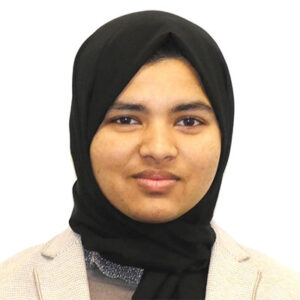
Kazi Afra Saiara from Fairfax, Virginia
Currently attending Chantilly High School

Logan Speight from Greensboro, North Carolina
Currently attending James B. Dudley High School

Sowmya Venkatesh from Pleasanton, California
Currently attending Amador Valley High School
Read their full profiles on the AIAA website. They will be recognized during the AIAA Awards Gala on Wednesday, 30 April, at Grand Hyatt Washington, Washington, DC. Tickets for the event are available now.
The Roger W. Kahn Scholarship was created to honor the memory of Roger W. Kahn (1907–1962) and his passion for aviation and entertainment. Kahn spent the latter part of his career at Grumman Aircraft Engineering Corporation as a test pilot and then managed the technical service and sales division. In the 1940s, he was actively involved with the Institute of the Aeronautical Sciences (one of the predecessor organizations of AIAA) and later served as its vice president.
Kahn also was an accomplished jazz musician as early as the 1920s, composing songs often featured in stage productions and early films, as well as leading numerous orchestras. He became a recording artist for some of the first record labels including Victor, Brunswick, and Columbia.
Kahn left a legacy gift to AIAA – a song called “Crazy Rhythm” – that he wrote in 1928. AIAA used the proceeds of his trust to establish the scholarship in 2020. Since then, 16 students have received the scholarship to pursue university degrees in engineering.
“AIAA is pleased to honor the memory of aviation pioneer Roger W. Kahn. His enthusiasm for aviation nearly 100 years ago will remain relevant in the next 100 years of innovation. The scholarship that bears his name will support four more bright minds driving the next technology breakthroughs in aerospace,” commented AIAA CEO Clay Mowry.
Laura McGill, chair of the AIAA Foundation, added, “The AIAA Foundation is pleased to use part of Roger W. Kahn’s gift to identify, mentor, and promote promising young aerospace talent on their first steps from classroom to career. We can’t wait to see them shape the future of aerospace.”
Contact: Rebecca B. Gray, [email protected], 804-397-5270 cell
About AIAA
The American Institute of Aeronautics and Astronautics (AIAA) is the world’s largest aerospace technical society. With nearly 30,000 individual members from 91 countries, and 100 corporate members, AIAA brings together industry, academia, and government to advance engineering and science in aviation, space, and defense. For more information, visit aiaa.org, and follow AIAA on X/Twitter, Facebook, LinkedIn, and Instagram.

ULA Vulcan Receives Certification for US National Security Missions
Via Satellite reports, “The United Launch Alliance (ULA) Vulcan rocket is now certified for U.S. national security missions after receiving certification from the U.S. Space Force. Space Systems Command’s (SSC) Assured Access to Space organization announced the certification on Wednesday for National Security Space Launch (NSSL) missions. ULA is now eligible to launch NSSL missions as one of two certified providers, the other being SpaceX.”
Full Story (Via Satellite)
NASA Completes SLS Core Stage Stacking for Next Year’s Artemis 2 Moon Mission
SPACE reports, “NASA’s next moon rocket is coming together, piece by piece. The core stage of NASA’s next Space Launch System (SLS) rocket recently completed integration with the vehicle’s side boosters inside the agency’s Vehicle Assembly Building in Florida. SLS will launch NASA’s Artemis 2 mission to fly four astronauts aboard an Orion spacecraft around the moon and back sometime next year.”
Full Story (SPACE)
Boeing to Test MQ-28 Ghost Bat Missile in Late 2025 or Early 2026
Aviation Week reports, “Boeing plans to fire an air-to-air missile from its MQ-28 Ghost Bat uncrewed combat aircraft demonstrator late this year or early next, as part of an effort to accelerate the system’s development, says Steve Parker, acting head of BoeingDefense, Space and Security. Boeing has now flown 102 missions with the system it has designed and built in Australia. The system ‘is really maturing,’ Parker told reporters here at the Avalon Australian International Airshow.”
Full Story (Aviation Week)
NASA’s Curiosity Mars Rover Discovers Large Organic Molecules
Aviation Week reports, “Samples of pulverized rock from the Martian surface gathered and analyzed by NASA’s Curiosity rover have found the largest collection of organic samples to date on the red planet. Findings published March 24 in the Proceedings of the National Academy of Sciences identifies the organics as molecular compounds of decane, undecane and dodecane, which are respectively comprised of 10, 11 and 12 carbon.”
Full Story (Aviation Week)
Isar Aerospace’s Spectrum Launcher Set to Overtake V-2 as Germany’s Largest Rocket
Ars Technica reports, “Seven years ago, three classmates at the Technical University of Munich believed their student engineering project might hold some promise in the private sector. At the time, one of the co-founders, Daniel Metzler, led a team of 40 students working on rocket engines and launching sounding rockets. Josef Fleischmann was on the team that won the first SpaceX Hyperloop competition. Together with another classmate, Markus Brandl, they crafted rocket parts in a campus workshop before taking the leap and establishing Isar Aerospace, named for the river running through the Bavarian capital.”
Full Story (Ars Technica)
Boeing Awarded Air Force’s Next-Gen Fighter Contract
Defense One reports, “Boeing will develop and build a sixth-generation fighter jet for the Air Force, President Donald Trump announced Friday, ending months of deliberation about whether to proceed with the effort and how much it might cost. ‘After a rigorous and thorough competition between some of America’s top aerospace companies, the Air Force is going to be awarding the contract for the Next Generation Air Dominance platform to Boeing,’ Trump said. Boeing beat out Lockheed Martin, its only rival for the NGAD contract after Northrop Grumman dropped out last year.”
Full Story (Defense One)
SpaceX Launches its 450th Falcon 9, Sets New Record for Booster Turnaround Time
Spaceflight Now reports, “The National Reconnaissance Office launched its eighth batch of satellites to support its proliferated architecture constellation. The mission includes a number of notable milestones for SpaceX’s Falcon 9 rocket program, including a record-fast turnaround time for its booster. The rocket carried an unspecified number of satellites that are believed to be Starshield, a government variant of the Starlink satellites that are built by SpaceX in partnership with Northrop Grumman. This was SpaceX’s 450th Falcon 9 launch to date.”
Full Story (Spaceflight Now)
Video
SpaceX launches a Falcon 9 for 450th time (Launch occurs at 32:38)
(Spaceflight Now; YouTube)
NASA to Continue Pursuit of Boeing Starliner Certification
Aviation Week reports, “NASA says it wants to stick with the Boeing CST-100 Starliner to give the space agency options in case the SpaceX Dragon system encounters problems. NASA last year had to lean on the SpaceX system when it experienced technical issues with Starliner during a Crew Flight Test (CFT) that turned a days-long mission into a months-long saga. The propulsion issues drove NASA to return the Boeing capsule to Earth uncrewed and make astronauts Barry Wilmore and Sunita Williams part of the International Space Station (ISS) crew. They returned to Earth March 18along with NASA’s Crew-9 Dragon commander Nick Hague and Russian cosmonaut Aleksandr Gorbunov.”
Full Story (Aviation Week)
