
In a recent podcast, “Aviation Week editors Graham Warwick and Guy Norris discuss some of the breakthrough technologies and advanced concepts to emerge at this year’s AIAA SciTech Forum in Florida. They also hear from AIAA’s new CEO, Clay Mowry.”
Listen to Podcast (Aviation Week
Tag: Florida
The ‘Golden Age’ of AI and Autonomy
Panel Highlights Critical Role of AI and Autonomy on Earth and in Space
By Anne Wainscott-Sargent, AIAA Communications Team
ORLANDO, Fla. – In the future artificial intelligence (AI) and autonomous systems will transform how people and assets are tracked, whether on Earth or in space, noted speakers on an AIAA SciTech Forum plenary on AI and Autonomy last Thursday, 9 January.
Advances in real-time monitoring and connectivity will help first responders act fast, said one panelist, recalling a 2012 Sausalito, California, road fatality caused when a man crashed his car following a heart attack. He was traveling alone at night, with no one aware of his location.
“In a world where we have a fully connected comms system, that plays out very differently,” said Eric Smith, senior principal, Remote Sensing and Data Analytics at Lockheed Martin Space.
Redefining Accident Response
Not only would AI wearable tech proactively monitor the man’s medical condition, it also would alert EMS and even coordinate traffic control systems to ensure the speediest response to his location.
The plenary session highlighted advancements in AI and their applications in simulation, safety, and decision making, as well as how autonomous systems are reshaping the future of space exploration.
“This is a golden age for robotics and autonomy,” noted Marco Pavone, lead autonomous vehicle researcher at Nvidia and an associate professor at Stanford University in the Department of Aeronautics and Astronautics.
His focus is fourfold: 1) develop visual language models for vehicle autonomy architectures, 2) find other ways of architecting autonomous tasks, 3) explore simulation technologies to enable end-to-end simulation of autonomous tasks in a realistic and controllable way, and 4) research AI safety – building safe and trustworthy AI systems, particularly in space systems and self-driving cars.
Pavone also co-founded a new center at Stanford – the Center for AEroSpace Autonomy Research (CAESAR), which was formed to advance the state of the art by infusing autonomous reasoning capabilities in aerospace systems.
“At the center we are looking at AI techniques for constructions tasks for other space systems and we’re even developing space foundation models that take into account specific inputs and outputs,” he said.
Lockheed Martin is using AI in all four domains of its business – Space, Missiles and Fire Control, Rotary Systems, and Aeronautics. The company envisions AI for autonomy in unstructured environments like the surface of the moon or Mars, with multiagent cooperative autonomy for manufacturing and assembly.
Smart Robots Likely to Precede Humans to Mars
“I foresee the first habitable, critical infrastructure on the surface of Mars being constructed by a team of robots using material and tools and high-level instructions that say, ‘Do the following things’ [in preparation] for humans to arrive,” said Smith.
On the ground, autonomy and AI advances will play an important role in land-use monitoring, to manage and coordinate disaster response and asset tracking, and will work even if objects pass under bridges or under cloud cover. Lockheed Martin Missiles and Fire Control has a department called Advanced Autonomy concerned with autonomous ground vehicles.
Better Fire Prediction and Detection
According to Smith, the group is exploring advanced technologies to help firefighters better predict, detect, and fight wildfires. The technology could predict and locate a fire hours before it even starts from a lightning strike. Using the power of AI, Lockheed’s technology could also analyze fire behavior in near real-time to enable fire growth predictions and to deliver persistent communications across multiagency air and land suppression units, so they might respond quicker to a large complex fire. Unfortunately, the technology is only in test mode; it’s not currently helping fight the fires ravaging southern California, said Smith.
Moderator Julie Shah, Department Head and H.N. Slater Professor in Aeronautics and Astronautics at Massachusetts Institute of Technology (MIT), discussed how much the world has changed in the context of AI over the last two decades.
Continually Evolving AI Systems
“When I did my Ph.D., it was on automated planning and scheduling with no machine learning,” recalled Shah. “When I started my career on faculty, I remember a colleague at NASA told me … nothing that learns online will ever fly in space. In the blink of an eye, a few years later, all I did in my lab was machine learning.”
Pavone agreed with Shah that future aerospace missions, especially for space exploration, will need AI systems that can continue to evolve and learn after they deploy.
“Adaptation is needed and so that’s something we are working on,” said Pavone, noting that his lab is collaborating with The Aerospace Corporation on AI systems that can serve anomalies – “How do you use those anomalies to train your system on the ground so that you can still do validation and then improve it?”
Following the panel, Pavone emphasized that foundation models, dark language, and vision language models all provide “several opportunities to rethink how we build autonomous systems.”
He pointed to several breakthroughs in simulation technologies, which will make simulation a powerful tool of autonomous systems.
Aerospace: Lessons from Automotive’s AI Experience
Pavone added that while the application domain he focuses on at Nvidia is primarily automotive (self-driving cars), aerospace researchers can learn from the automotive industry.
“The automotive [industry] has been building AI systems for a while now, and they have built quite a bit of competence in terms of which AI system should be fielded and also how to provide that they are safe and reliable. So, both the methodologies and the safety standards that have been developed by the automotive community could be useful for the aerospace community,” he said.
Forum Attendees Weigh In On AI
Following the plenary, Jorge Hernandez, president of Texas-based Bastion Technologies, said, “Just the opportunity to hear how different organizations are working with AI was fantastic. What Stanford, Lockheed, and MIT are doing is exceptional. We’re all interested in seeing how that will impact us in the future…and we’re all interested getting involved.”
His firm focuses on safety and mission assurance and mechanical engineering, said Hernandez. “We get involved on the risk and analysis side, so how AI plays into that will be an important piece of what we do.”
Rudy Al Ahmar, a PhD student who is completing his aerospace engineering studies at Auburn University’s Advanced Propulsion Research Laboratory this semester, agreed with the panelists – there was a lot of skepticism about AI and machine learning five years ago, but those concerns were addressed within a few years. The same thing has happened with generative AI.
“For a lot of scientists and researchers, it’s not a matter of if they’re going to use AI and machine learning, it’s a matter of when and how they’re going to implement it – whether on a large scale or small scale,” he said.
The doctoral candidate said he hopes to research AI and machine learning integration with computational fluid dynamics (CFD) as a university assistant professor.
“It’s computationally demanding to work on these aerospace applications with CFD. AI and machine learning can reduce the computational cost and make things rapid so you can optimize and study things much, much quicker.”
On Demand Recording Available
Sustainable Aviation Fuels and Advanced Propulsion Tech Will Help Industry Achieve Net Zero Goals by 2050
By Anne Wainscott-Sargent, AIAA Communications Team
ORLANDO, Fla. – An expert panel composed of three top aviation original equipment manufacturers (OEM), NASA, and the U.S. Department of Energy tackled how propulsion technology will drive the industry to achieve its goals for net zero carbon emissions by 2050 during the 2025 AIAA SciTech Forum.
Panelists emphasized fleet renewal, sustainable aviation fuels, and advanced propulsion technologies to help the industry achieve its carbon-mitigation goals.
“Aerospace is one of the hardest sectors to decarbonize,” noted Peter de Bock, program director for the Department of Energy’s Advanced Research Projects Agency-Energy (ARPA-E).
Organized similarly to DARPA, ARPA-E advances high-potential, high-impact energy technologies that are too early for private-sector investment. ARPA-E awardees are unique because they are developing entirely new ways to generate, store, and use energy.
“We take high-risk bets on the next generation of technology. What are things that the world would need 10 years from now?”
His agency is focusing closely on the transportation sector, which leads emissions over power generation, said de Bock, who predicts that the industry will get more scrutiny starting in 2030 and through the next decade.
“We see multiple modalities to be the path to the future. Anything you can do fully electric… can push the efficiency to 75 or 80%. That’s a big deal. It’s extremely hard but worth the try.”
ARPA-E supports innovative technologies across the spectrum, including high-temperature alloys, atmospheric sensors, and sustainable aviation fuel production.
Low-hanging fruit for several aviation engine builders centers on technology improvements that drive fuel efficiency given how much fuel costs airlines’ bottom lines.
More Efficient Propulsion
Michael Winter, chief science officer at RTX, and senior fellow of Advanced Technology at Pratt & Whitney, said 30–40% of the cost of running an airline and a modern airport is fuel.
“Propulsion efficiency really comes down to the fan or propulsor and the bypass in the nozzle,” he said.
Pratt & Whitney in 2016 introduced a geared-fan architecture that has enabled a 16% improvement in fuel efficiency, noted Winter. Its geared turbofan (GTF) engine technology uses a specially designed fan that rotates at a slower speed while still achieving high bypass ratios, leading to significant fuel savings and reduced noise emissions compared to previous engine designs.
“As we look to the future, we see opportunities for greater efficiency – number one, going to higher thermal efficiency in engines, which over the last 85 years has improved about 400%.” Winter added that higher thermal efficiency creates higher temperatures requiring new material systems and better cooling.
Saving Fuel with Propulsive Technology
On the propulsion technology front, GE Aerospace is embracing open fan technology. While not a new technology, it has matured over the last decade and a half, allowing it to be “as fast as a jet, [quiet], and 20% more efficient than today’s engines,” according to a recent GE Aerospace blog post.
GE Aerospace recently was awarded 840,000 hours on the Frontier supercomputer through the agency’s INCITE program. INCITE is a highly competitive program that supports the world’s most computationally intensive projects. Frontier was introduced in depth at another session during the forum by Bronson Messer II, director of science for the Leadership Computing Facility at Oak Ridge National Laboratory (ORNL). (Read more on Frontier here.)
In November, the company announced a new project with Boeing, NASA, and ORNL to model the integration of an open fan engine design with an airplane.
UK-based Rolls-Royce is pursuing continuous improvement in its gas turbine and power systems, including materials, cooling, and cycle efficiencies. Steve Wellborn, the company’s senior fellow, said enhanced integration at the platform level will be critical for achieving these breakthroughs in fuel efficiency.
Embracing Whole-System Integration
Wellborn added that he sees a lot of manufacturing, digital, and service technologies coming together. “You’re no longer just bolting engines onto an aircraft; you have to think of the whole system together.”
“At the forefront of this has to be safety,” he said.
Kathleen Mondino, manager of RISE Technology Maturation at GE Aerospace, also considers integration a critical trend. She predicts the future will be one that leverages open fan technology – “that means viewing the engine and aircraft together as one system, which hasn’t been done before.”
Filling Capability Gaps
NASA Glenn Research Center provides avionics providers with the tools and capabilities for optimization and simulation they need when looking at new architectures.
“We also look at where there might be a gap where there are lower technology readiness levels and do some work in that,” said Joseph Connolly, deputy for Electrified Aircraft Propulsion Integration at NASA Glenn Research Center.
NASA is supporting several papers at the forum looking at concepts for hybrid-electric configuration with distribution propulsion to see what benefits the technologies might offer industry partners in the future.
Connolly also shared details on NASA’s work on the Electrified Powertrain Flight Demonstration project, involving GE Aerospace and magniX, to develop a megawatt-class powertrain for commercial aircraft by the 2030s. The project includes a parallel hybrid architecture for a Saab 340 and a regional turboprop demonstrator for a Dash 7.
NASA’s efforts focus on addressing key barriers in electrification, including high voltage at altitude and battery system performance.
Investing in Sustainable Fuels
Sustainable fuels are a big area of investment across the OEM community. “We see huge opportunities in hydrogen,” said Winter, citing the new HySIITE (Hydrogen, Steam Injected Intercooled Turbine Engine) concept, shown to be 35% more efficient while reducing oxides of nitrogen by 99.3% and recapturing one gallon of water every three seconds.
Capitalizing on Coming Fleet Renewals
Moving aircraft to more efficient propulsion will likely occur at the end of this decade, said Mondino.
“GE Aerospace is laser focused on the narrow-body market,” she said, adding that those aircraft fleets are up for renewal toward the end of this decade or at the beginning of the next.
She emphasized that making this transition will require “a big step change” in how the OEM market approaches product innovation and problem-solving.
“You’ve got to break out of the box that you’re currently in,” she said.
Celebrating Diverse Voices in Aerospace at AIAA SciTech Forum
By Anne Wainscott-Sargent, AIAA Communications Team
ORLANDO, Fla. – On the final evening of the 2025 AIAA SciTech Forum, female aerospace leaders, students, and allies gathered for an engaging discussion on the unique experience of women in aerospace and how to navigate interpersonal, gender, and cultural dynamics for long-term professional and personal success.
“Throughout my career I have witnessed the power of diverse perspectives and how they drive innovation, tackle complex challenges, and lead technology through development,” said panel moderator Soumya Patnaik, a principal aerospace engineer at the Air Force Research Lab. “This evening is all about celebrating that diversity.”
Patnaik added that aerospace isn’t just about technology; “it’s about people – our ideas, our collaboration, and our shared drive to keep moving forward.”
How does one attract people of different backgrounds and experience? Sonya Smith said it starts by being inclusive. Smith is professor and executive director of the Research Institute for Tactical Autonomy at Howard University. “Make sure that you’re going beyond your comfort zone, to reach out to different populations, to people with different experiences.”
In academia, that might mean reaching out to community colleges instead of only four-year universities.
“I look to raise the voices of women and bring them to more leadership positions,” added panelist Melike Nikbay, professor of Aerospace Engineering and chair of the Astronautical Engineering Department at Istanbul Technical University.
Her outreach to young people extends to her role representing Turkey with NATO’s Science and Technology Organization Applied Vehicle Technology Panel, where she has served for over 16 years and contributes scientific work to the research task groups.
Clearly, the issue of diversity isn’t just about gender – it can be about diversity of experience, be it cultural differences or age. While sharing their own experiences, the panelists offered practical advice to current professionals and the up-and-coming generation of engineers.
“Success is defined by you, nobody else,” said panelist Anna-Maria McGowan, national senior engineer for complex system design at NASA Langley Research Center. “We are so much more than our job.”
McGowan, a native of the Caribbean, said she turned down promotions because she knew the new roles would take her away from her family. McGowan’s son, an undergraduate engineering student attending Pennsylvania State University, watched his mom on stage as he attended his first AIAA SciTech Forum.
Afterward he said, “What she said reflected a lot of how she raised me – it was very familiar. My mom really encouraged me to get into a lot of different things. I’ve lived in ice caves for days in Colorado; I’ve studied abroad in Singapore. I run a product design team right now where about half (the members) are underrepresented.”
Smith advised engineering graduates who are looking to start families to be selective about where they choose to work. “Look for organizations that support family-friendly policies. Choose carefully where you start your career.”
“Be who you are,” urged Karen Roth, deputy director of AFWERX, the innovation arm of the Department of the Air Force, who also serves as the president of the Society of Women Engineers. Roth said those times when she wasn’t her authentic self to fit in never worked out.
Embracing Diversity Makes Business Sense
“Wall Street requires organizations to have diverse boards because they know that diversity has a profitability impact,” noted Roth.
As a mother, she brings skills to the work setting that allow her to be a better communicator, which is helpful when dealing with people interpersonally who may not have strong communication skills. In those instances, “understanding context” proves extremely helpful.
McGowan acknowledged that conversations about diversity, equity, inclusion, and accessibility have become a challenging topic for everybody.
“People are afraid if they mention it, they’ll (be viewed as) ‘pulling the race or gender card,’” the NASA career professional said.
She urged people to resist staying silent and for leaders to have honest discussions with their teams.
“Let’s make the conversation about diversity comfortable and engaging. It may mean we need to educate ourselves. We as leaders and future leaders need to have those conversations.”
After the panel, first-time AIAA SciTech Forum attendee Funmi Adeeye said her decision to attend the panel was easy. “I get inspired whenever I see women doing something great.”
The Nigerian native and Stanford University engineering student said she liked the advice from one of the panelists – to accept that you will make mistakes and to extend grace to yourself and to others.
“Be kind to yourself. In school, there’s always a chance to make things better,” she said.
Also in the audience was Joseph Connolly, an aerospace engineer with NASA Glenn Research Center in Cleveland and former member of the AIAA Diversity Working Group.
“I’ve been coming to the Women at SciTech discussion every year since I’ve been attending the forum,” he said. “The panels are always phenomenal. There’s usually some inspirational and refreshing words of ways to work through tough situations, and how to make sure you’re giving yourself a nice balance between your family life and your work life.”
Aerospace America: U.S. Air Force Electrified Aircraft Program Gets Help From Congress on Tech Transition Goal
ORLANDO, Fla. – Aerospace America reports, “The director of the division that runs the U.S. Air Force program to research emerging electric aircraft, AFWERX Agility Prime, is eager to see one or more of those aircraft designs transitioned into active military service.
Full Story (Aerospace America)
Aerospace America: Bringing Home a Piece of Space History
ORLANDO, Fla. – Aerospace America reports, “Authors of a technical paper at the 2025 AIAA SciTech Forum describe how Vanguard 1, the second U.S. satellite, could be retrieved, analyzed and displayed at one of the Smithsonian museums.”
Full Story (Aerospace America)
ORNL: Troubleshooting Turbulence – the Next ‘Killer App’ for Exascale Supercomputing?
By Anne Wainscott-Sargent, AIAA Communications Team
ORLANDO, Fla. – The aerospace community got a rare look at the capabilities and processing might of the world’s first exascale supercomputer during a plenary session at the 2025 AIAA SciTech Forum.
Taking the stage in Orlando, Bronson Messer II, director of science for the Leadership Computing Facility at Oak Ridge National Laboratory (ORNL) in eastern Tennessee, admitted that while he is an astrophysicist, not an engineer, he shares common interests with the AIAA community: namely, solving tough problems in a world where the pace of technology advances continues to slow – even as the need for smarter, more advanced problem-solving is accelerating.
“I’ve heard throughout my career that Moore’s Law is dead. It’s finally actually true. This…doubling of performance…every 18 months has hit the end of the road,” he explained.
Messer said Moore’s Law’s demise requires scientists to think about how they’re going to reformulate problems and solve them in a much different way. And one of the biggest technical challenges facing the aerospace engineering community is turbulence.
“Turbulence may be the killer app for exascale computers,” Messer said.
Turbulence has a complex and unpredictable nature, making it difficult to accurately model and predict. That’s especially true for “clear-air turbulence,” which is invisible to radar. A 2023 study found that aircraft turbulence soared by up to 55% and some regions, including North America, the north Atlantic, and Europe, are set to experience several hundred percent more turbulence in the coming decade.
Enter Frontier, ORNL’s exascale supercomputer, which became operational in 2022 with 100 times the computing power found in typical universities, labs, or industrial environments. It can process billions upon billions of operations per second. Frontier’s processing speed is so powerful, it would take every person on Earth combined more than four years to do what the supercomputer can in one second.
“Frontier has more in common with the Hubble Space Telescope or the Large Hadron Collider (a particle accelerator) than with your laptop,” Messer emphasized.
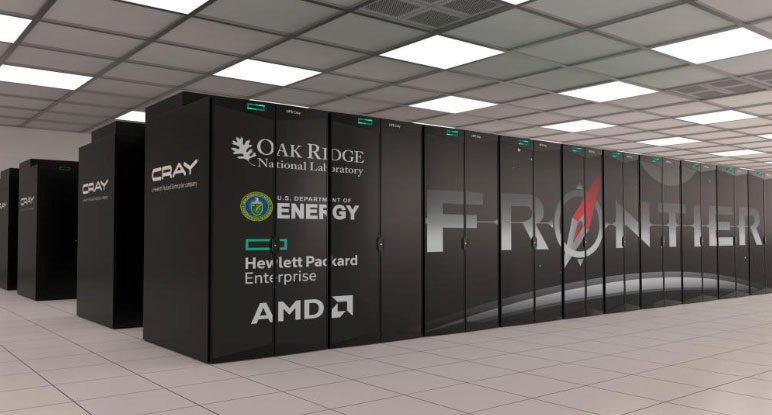
Messer shared how GE Aerospace did one of the largest turbulence simulations ever attempted to study ways to negate the effect of turbulence on commercial flights. NASA is leveraging Frontier to understand the role of turbulence in flying and landing on Mars.
Concluding his talk, Messer invited proposals year-round from the audience to get time on the Frontier system, which is open to U.S. and most global researchers with some exceptions. He cautioned that only projects with the right level of computing complexity will benefit from exascale computing.
During the Q&A he said that his team has concluded an RFP for Discovery, the next exascale supercomputer that will replace Frontier.
When asked about exascale computing’s role in quantum computing, Messer said, “I’m a quantum advocate. My suspicion is over the next decade quantum computing will make the biggest impact on what I would call quantum problems – problems like computational chemistry, which may have an impact on things like aerospace.” He said there is a small team at ONRL looking at doing compressible hydrodynamics using quantum computing.
“I think the ability to do that on a very large scale is a way off,” he concluded.
“It was a very interesting talk,” said forum attendee Mike Ferguson, a flight test engineer at Johns Hopkins Applied Physics Lab in Maryland. “I definitely think there are problems at our lab that could use that kind of computing infrastructure, but it would take some investigating and some actual deep thinking from all of us to figure that out.”
On Demand Recording Available
The Next Generation of Spacesuits Being Designed Digitally
Former Astronaut Leads Development of Virtual Digital Twins for High-Performance, Custom-Fit Extravehicular Activity (EVA) Spacesuits
By Anne Wainscott-Sargent, AIAA Communications Team
ORLANDO, Fla. – During her astronaut career flying on five Space Shuttle missions, Professor Bonnie J. Dunbar recalls the challenges of ill-fitting EVA “modular, mix-and-match” spacesuits. Ironically, it was during training in Russia as a crewmember traveling to the Russian Space Station Mir, that she experienced the advantages of a customized, pressurized spacesuit.
Speaking on day three of the 2025 AIAA SciTech Forum in Orlando about spacesuit advances, Dunbar shared how she was so comfortable in the customized Sokol Pressure suit, that she napped for four hours while testing the suit/SOYUZ seat combination in a vacuum chamber at Star City, home to the Yuri Gagarin Cosmonaut Training Center in Moscow.
Challenges with Fit and Customization
“Poorly fitting pressure suits that reduce mobility and have a high energy cost impact both mission success and safety. But customization had not been used since the Apollo program, where each crewmember had three custom suits: one for flight, one for back-up, and one for training,” she explained.
During the Shuttle program era, NASA went to a modular design for suits with five “chest sizes” and mix-and-match set of arms and legs, said Dunbar, recalling that the result was “suits that didn’t fit everyone as well as they should.” Some astronauts experienced injuries during missions such as shoulder issues that required surgery when they returned home. These problems are currently captured as risks by both the NASA engineering and human research organizations.
She asked: “How can we use new modern digital engineering tools to revisit customization to maximize performance, and reduce injury, in a cost-effective and schedule-sensitive manner?”
Today, as director of the Aerospace Human Systems Laboratory in the Aerospace Engineering Department at Texas A&M University, Dunbar is bringing her unique experience to bear, spearheading research that could inform what future astronauts will wear on missions to Mars and teaching students about “Human Systems Integration.”
NASA Funds Digital Thread Research
NASA was so interested in her digital concept that they gave her a Phase 1 NIAC (NASA Innovative Advanced Concepts) grant for the development of an EVA suit digital thread. Using tools such as 3D human scanners and finite element (FEA) technology to model the pressurized fabric layers of the suits, she hopes to create a digital system where custom spacesuits, optimized for joint mobility and energy expenditure before manufacture, will become a reality. This step in the digital thread is called “the virtual twin.”
“Spacesuits are not a fashion statement,” said the former NASA astronaut. Instead, think of it as “a human-shaped spacecraft.”
In addition to being pressurized, the 14-layer EVA suit generally includes a communication system, life support (oxygen for breathing and CO2 removal), thermal management, displays and controls, battery power, computers, advanced materials, radiation mitigation, micro-meteoroid protection, and sensors. When pressurized, fabrics become rigid (think of a balloon). If the joints are not properly designed or positioned with respect to the astronauts’ joints, an astronaut can lose as much as 50% of their effective strength, experience reduced mobility, and expend more energy in required EVA exploration tasks.
Dunbar’s research could also benefit current efforts by Axiom Space, which is designing the new EVA suit for the lunar Artemis mission. Axiom unveiled the AxEMU (Axiom Extravehicular Mobility Unit) prototype in spring 2023. Featuring new tech, safety features, and enhanced comfort and mobility, the AxEMU includes innovative life-support systems, pressure garments, and avionics. It’s designed to accommodate 1%-99% of the U.S. population.
Having a future tool to virtually evaluate the suit for that large range of anthropometric sizes before manufacturing could mitigate future performance challenges. SpaceX is currently designing customized suits, but could also benefit from virtual performance evaluations (virtual twin) prior to manufacture.
The Gold Standard for Spacesuit Design
Dunbar considers the dual goals of maximizing mobility and reducing energy expenditure “the gold rings” for spacesuit design.
“I wanted to take it [spacesuit design] from the Pillsbury Doughboy stage to ‘The Martian’ stage,” said Dunbar, referring to the advancements in suit design from the 1970s and 1980s to what was shown in the futuristic Mars adventure film starring Matt Damon.
Using human digital scanners such as 3dMD and VITUS in her lab that can deliver millimeter accuracy, she took the approach of aircraft designers: building a virtual twin.
“The goal is to integrate the virtual suit with the virtual person, and to model the torque and forces required to deform a pressurized joint using FEA tools,” explained Dunbar. “By iterating sleeve dimensions, joint designs, material properties, and delta pressures through sensitivity testing, we can identify critical factors for performance.”
Dunbar has advised one Ph.D. student and three M.S. students on this topic, all with published papers, both for modelling and breadboard testing. She plans to present an overview of the current research later this year.
Raising the TRL of the Virtual Twins for Suit Design
“We’re continuing our work,” she said, estimating that her lab’s efforts to build virtual twins for suit design is currently at Technology Readiness Level (TRL) 3-4. To raise the TRL will require industry partners,” Dunbar said.
The Texas A&M researcher’s vision for tomorrow’s astronauts is powerful yet simple: “I step into the scanner. A few days later, I have a suit that comfortably fits and is mobile, and because it may be designed for Mars, it will be reliable, relatively simple, and easily repairable.”
While it’s still early days, Dunbar is hopeful that her lab is on the right path to create a future platform that delivers on that vision.
To learn more about Bonnie Dunbar’s innovative work and the process envisioned to support future spacesuits, check out a 2023 NASA/NIAC book, Made-to-Order Spacesuits featuring NASA Inventor Bonnie Dunbar.
USAF Science & Technology Chief: New Urgency to Embrace Digital Transformation to Strengthen the Force’s Resiliency and Ability to Compete Against Near-Peer Rivals
By Anne Wainscott-Sargent, AIAA Communications Team
Watch On Demand
ORLANDO, Fla. – The ability to field critical capabilities in the U.S. Air Force (USAF) has never been more urgent, a senior Air Force official told AIAA SciTech Forum attendees.
“We are in competition with near-competitive nations and China in particular is now on par to deliver new capabilities in seven years or less,” said Kristen Baldwin, deputy assistant secretary of the Air Force.
She noted that in comparison, USAF programs take an average of 16 years to deliver new capability. “We see digital transformation as a true disruptive business practice that we can bring to bear. We have to invest now – we have to invest in new capabilities.”
Baldwin, speaking via Zoom on the second day of the forum, oversees a $5 billion budget across multiple research sites worldwide, focusing on digital engineering, cyber resiliency, and the service’s science and technology portfolio.
She described the Air Force’s digital materiel management approach, which includes six key initiatives to enhance data security, training, and IT infrastructure. Baldwin also outlined the integration of digital strategies across the Air Force and Space Force, including putting the government’s Modular Open Systems Architecture (MOSA) and other government reference architectures as requirements in contracts. MOSA is the cornerstone of new and legacy platforms and weapons.
Baldwin also mentioned the five pillars of the Air Force’s engineering strategy that has been embraced by U.S. allies, particularly in the UK and Australia. Her team’s Digital Materiel Management (DMM) approach has led to both schedule acceleration and technology improvements.
She stressed the need for continuous engagement with industry partners and international collaborations to drive digital transformation forward. The USAF has created two digital consortia – the Industry Association Consortium (IAC) and the Digital Acceleration Consortium (DAC). The IAC provides an open collaborative opportunity for the defense industrial base to help identify barriers and develop solutions associated with the rapid, full-scale adoption of DMM. The DAC recommends solutions modernizing IT infrastructure, compatible Integrated Digital Environments, secure access to data, and common data standards, policy, and contracting language.
During the Q&A, Baldwin agreed that as government goes more digital, it will be more vulnerable to cyber attacks.
“We have to implement that cyber resilience to really manage our data. We can’t rely on just network and perimeter defense. We’ve got to be able to implement and manage that security of our data, so these environments we’re building and the way we classify that data is a key foundational element of our digital transformation approach. We have to be agile in the way we can maneuver to respond to cyber threats. We have to be continuously aware and adapt,” she said.
The final question ended on a fun note: What did Baldwin consider the most feasible technological innovation from the Star Wars universe that could be developed within the next 50 years, and what challenges would engineers and scientists face in making it a reality?
“I love the idea of robotics and image holograms. The advancement of robotics as well as holograms can really help to transform the way that we support our forces. When we think of this urgency in national security, we’re going to find ourselves in situations where we are not going to have the ability to wait for delivery of future capability. We’ll have to reset and regroup in place.”
Responding to Baldwin’s presentation, Terry Hill, digital engineering program manager for NASA in Washington, D.C., said, “It’s good to hear the Air Force’s plan. Their approach to MOSA and their commitment to moving to a digital ecosystem is refreshing because that’s where NASA is wanting to go and we’re trying to work across agencies to best leverage all our different investments.”
Hill added that the Air Force’s emphasis on cybersecurity also benefits civil agencies like NASA. “Focusing on different areas and sharing solutions is definitely the way forward,” he said.
On Demand Recording Available
NASA Calls for Continuous American ‘Heartbeat’ in LEO
New Strategy for Sustaining U.S. Presence in Low Earth Orbit Announced
By Anne Wainscott-Sargent, AIAA Communications Team
ORLANDO, Fla. – When NASA retires the International Space Station by the end of 2031, the space agency intends for the United States to not just have capability in microgravity, but to have a continuous “heartbeat” in low Earth orbit, emphasized NASA Associate Administrator Jim Free as he unveiled NASA’s Low Earth Orbit (LEO) Microgravity Strategy during the 2025 AIAA SciTech Forum in Orlando.
The announcement follows last month’s release of NASA’s publication of its final LEO goals and objectives, which inform its long-term strategy to advance microgravity science, technology, and exploration. The framework aims to sustain human presence in orbit, drive economic growth, and strengthen international partnerships.
“A continuous heartbeat is what we have had today [with the ISS] for 24 years – a true, unbroken, continuous presence, where there’s always a person living and working in space,” said Free. “It’s written in US policy. It affects our national posture. Truthfully, if we don’t have continuous heartbeat, we risk not being the partner of choice for our international partners. We risk ceding low Earth orbit to others.”
Speaking to a global gathering of 6,000+ engineers and other technical aerospace leaders from commercial firms, government and academia, Free outlined NASA’s strategy for ensuring this continued presence, even as the agency prepares to support the transition of LEO.
Free, an Ohio native who began his NASA career in 1990 as a propulsion engineer at Goddard Space Flight Center, was inducted as a new AIAA Associate Fellow this year. He discussed the role of the ISS as a “beacon of what humanity can do when we work together.”
“For over 24 years, the ISS has allowed us to partner and continuously live and work off the planet,” said Free. “Its value goes beyond symbolism. It has been a cornerstone of our human space flight program…laying the foundation for everything we’re building toward today.”
To date, the ISS has hosted nearly 4,000 research and educational investigations from over 100 countries.
He cited examples of research on the ISS that has driven better understanding of how the human body reacts to being in space for long time periods as well as biopharma breakthroughs such as protein crystal growth that has improved the formulation of cancer drugs. One investigation with Merck has resulted in better ways to deliver cancer drugs using an injection instead of an IV.
NASA’s LEO strategy remains integral to its broader ambitions for deep space exploration. The microgravity environment in LEO offers a cost-effective, easily accessible proving ground for technologies and research necessary for human missions to explore the solar system.
As part of its LEO sustainment strategy, NASA will award contracts through the agency’s in-space production applications to support commercial development of new and promising technologies for in space manufacturing of advanced materials and products for use on Earth, as well as semiconductor materials and optical fiber production. According to Free, a key need from industry partners is better environmental control and life support systems on spacecraft or habitats.
“With most of the journey to Moon and Mars occurring in microgravity, the objectives give the opportunity to continue vital human research, test future exploration systems, and retain the critical skills needed to operate in the microgravity environment,” stated NASA publicly in late December.
NASA needs the United States to continually operate in LEO as it launches long-duration trips as a warm-up to Mars, and to ensure there are affordable and frequent commercial transport options to support the traffic to and from low Earth orbit. The agency plans to issue a second RFP this June for its Commercial Low Earth Orbit Development Program, designed to support the development of commercially owned and operated LEO destinations from which NASA, along with other customers, can purchase services and stimulate the growth of commercial activities in LEO.
“Our primary need is to mitigate risk for future trips to Mars with long duration flights in LEO of six months to a year. With the time we have left on ISS, we won’t have a statistically significant population of six-to-12-month missions to properly understand the risks of going to and returning from Mars,” he told AIAA SciTech Forum attendees.
The final framework includes 13 goals and 44 objectives across seven key areas: commercial low Earth orbit infrastructure, operations, science, research and technology development for exploration, international cooperation, workforce development and STEM engagement, and, public engagement.
Free said a key component of developing the strategy was weighing input from industry partners, whose feedback has served as “a cornerstone of the strategy.” NASA received 1,800 pieces of input during two workshops hosted in the UK and in Washington, D.C. last year.
“The comments we got were incredibly helpful,” said Free, who indicated the feedback validated the strategy. One piece of input from European space partners was the desire for faster scientific return, and as a result, “we added a new goal and objective around rapid LEO science to help us increase the pace of research.”
The input also led to a new objective for public engagement focused on collaborating NASA’s communication efforts to reach new audiences.
The new LEO strategy supports the United States’ national posture, or global standing as a leader in space.
During the Q&A, Free touched on a variety of topics, including NASA’s commitment to going to the moon, the agency’s digital engineering approach, the most exciting impact of AI on NASA’s work, and advice to AIAA’s technical committees and the new generation of aerospace workers.
He said AIAA remains an invaluable partner to NASA and its technical committee a valuable source of free-flowing discussions and ideas. He urged AIAA members to give feedback on the second draft RFP when it comes out.
“We need the feedback so the Commercial LEO Destinations program can be better,” he said.
Free also reiterated how important it is for the United States to continue to lead in space.
“If you try and think about a world where we do not lead in space – I have not experienced that in my lifetime, and I don’t want to,” he concluded.
Following the presentation, Karen Barker, an AIAA member since 1993, called NASA’s strategy for a sustained presence in LEO “very encouraging.”
“He explained why LEO is so important for us – a pillar on which to build to go other places. It’s extremely important that we keep our heartbeat in LEO,” she said, adding that she was pleased how open NASA is to getting feedback from industry, both on the LEO strategy and the upcoming RFP.
“It’s so important for us as a community to do that,” said Barker, CEO of Alabama-based BRAHE Corporation, a consulting firm that serves defense and aerospace clients.
On Demand Recording Available
# # #
Read NASA’s vision for the next generation of human presence in low Earth orbit and how the agency envisions achieving this future.