
Tag: January 8

The Next Generation of Spacesuits Being Designed Digitally

Former Astronaut Leads Development of Virtual Digital Twins for High-Performance, Custom-Fit Extravehicular Activity (EVA) Spacesuits

By Anne Wainscott-Sargent, AIAA Communications Team

ORLANDO, Fla. –  During her astronaut career flying on five Space Shuttle missions, Professor Bonnie J. Dunbar recalls the challenges of ill-fitting EVA “modular, mix-and-match” spacesuits. Ironically, it was during training in Russia as a crewmember traveling to the Russian Space Station Mir, that she experienced the advantages of a customized, pressurized spacesuit.

Speaking on day three of the 2025 AIAA SciTech Forum in Orlando about spacesuit advances, Dunbar shared how she was so comfortable in the customized Sokol Pressure suit, that she napped for four hours while testing the suit/SOYUZ seat combination in a vacuum chamber at Star City, home to the Yuri Gagarin Cosmonaut Training Center in Moscow.

Challenges with Fit and Customization

“Poorly fitting pressure suits that reduce mobility and have a high energy cost impact both mission success and safety. But customization had not been used since the Apollo program, where each crewmember had three custom suits: one for flight, one for back-up, and one for training,” she explained.

During the Shuttle program era, NASA went to a modular design for suits with five “chest sizes” and mix-and-match set of arms and legs, said Dunbar, recalling that the result was “suits that didn’t fit everyone as well as they should.”  Some astronauts experienced injuries during missions such as shoulder issues that required surgery when they returned home. These problems are currently captured as risks by both the NASA engineering and human research organizations.

She asked: “How can we use new modern digital engineering tools to revisit customization to maximize performance, and reduce injury, in a cost-effective and schedule-sensitive manner?”

Today, as director of the Aerospace Human Systems Laboratory in the Aerospace Engineering Department at Texas A&M University, Dunbar is bringing her unique experience to bear, spearheading research that could inform what future astronauts will wear on missions to Mars and teaching students about “Human Systems Integration.”

NASA Funds Digital Thread Research   

NASA was so interested in her digital concept that they gave her a Phase 1 NIAC (NASA Innovative Advanced Concepts) grant for the development of an EVA suit digital thread. Using tools such as 3D human scanners and finite element (FEA) technology to model the pressurized fabric layers of the suits, she hopes to create a digital system where custom spacesuits, optimized for joint mobility and energy expenditure before manufacture, will become a reality. This step in the digital thread is called “the virtual twin.”

“Spacesuits are not a fashion statement,” said the former NASA astronaut. Instead, think of it as “a human-shaped spacecraft.”

In addition to being pressurized, the 14-layer EVA suit generally includes a communication system, life support (oxygen for breathing and CO2 removal), thermal management, displays and controls, battery power, computers, advanced materials, radiation mitigation, micro-meteoroid protection, and sensors. When pressurized, fabrics become rigid (think of a balloon). If the joints are not properly designed or positioned with respect to the astronauts’ joints, an astronaut can lose as much as 50% of their effective strength, experience reduced mobility, and expend more energy in required EVA exploration tasks.

Dunbar’s research could also benefit current efforts by Axiom Space, which is designing the new EVA suit for the lunar Artemis mission. Axiom unveiled the AxEMU (Axiom Extravehicular Mobility Unit) prototype in spring 2023. Featuring new tech, safety features, and enhanced comfort and mobility, the AxEMU includes innovative life-support systems, pressure garments, and avionics. It’s designed to accommodate 1%-99% of the U.S. population.

Having a future tool to virtually evaluate the suit for that large range of anthropometric sizes before manufacturing could mitigate future performance challenges. SpaceX is currently designing customized suits, but could also benefit from virtual performance evaluations (virtual twin) prior to manufacture.

The Gold Standard for Spacesuit Design

Dunbar considers the dual goals of maximizing mobility and reducing energy expenditure “the gold rings” for spacesuit design.

“I wanted to take it [spacesuit design] from the Pillsbury Doughboy stage to ‘The Martian’ stage,” said Dunbar, referring to the advancements in suit design from the 1970s and 1980s to what was shown in the futuristic Mars adventure film starring Matt Damon.

Using human digital scanners such as 3dMD and VITUS in her lab that can deliver millimeter accuracy, she took the approach of aircraft designers: building a virtual twin.

“The goal is to integrate the virtual suit with the virtual person, and to model the torque and forces required to deform a pressurized joint using FEA tools,” explained Dunbar. “By iterating sleeve dimensions, joint designs, material properties, and delta pressures through sensitivity testing, we can identify critical factors for performance.”

Dunbar has advised one Ph.D. student and three M.S. students on this topic, all with published papers, both for modelling and breadboard testing. She plans to present an overview of the current research later this year.

Raising the TRL of the Virtual Twins for Suit Design  

“We’re continuing our work,” she said, estimating that her lab’s efforts to build virtual twins for suit design is currently at Technology Readiness Level (TRL) 3-4. To raise the TRL will require industry partners,” Dunbar said.

The Texas A&M researcher’s vision for tomorrow’s astronauts is powerful yet simple: “I step into the scanner. A few days later, I have a suit that comfortably fits and is mobile, and because it may be designed for Mars, it will be reliable, relatively simple, and easily repairable.”

While it’s still early days, Dunbar is hopeful that her lab is on the right path to create a future platform that delivers on that vision.

To learn more about Bonnie Dunbar’s innovative work and the process envisioned to support future spacesuits, check out a 2023 NASA/NIAC book, Made-to-Order Spacesuits featuring NASA Inventor Bonnie Dunbar.

USAF Science & Technology Chief: New Urgency to Embrace Digital Transformation to Strengthen the Force’s Resiliency and Ability to Compete Against Near-Peer Rivals

By Anne Wainscott-Sargent, AIAA Communications Team
Watch On Demand 

ORLANDO, Fla. – The ability to field critical capabilities in the U.S. Air Force (USAF) has never been more urgent, a senior Air Force official told AIAA SciTech Forum attendees.

“We are in competition with near-competitive nations and China in particular is now on par to deliver new capabilities in seven years or less,” said Kristen Baldwin, deputy assistant secretary of the Air Force.

She noted that in comparison, USAF programs take an average of 16 years to deliver new capability. “We see digital transformation as a true disruptive business practice that we can bring to bear. We have to invest now – we have to invest in new capabilities.”

Baldwin, speaking via Zoom on the second day of the forum, oversees a $5 billion budget across multiple research sites worldwide, focusing on digital engineering, cyber resiliency, and the service’s science and technology portfolio.

She described the Air Force’s digital materiel management approach, which includes six key initiatives to enhance data security, training, and IT infrastructure. Baldwin also outlined the integration of digital strategies across the Air Force and Space Force, including putting the government’s Modular Open Systems Architecture (MOSA) and other government reference architectures as requirements in contracts. MOSA is the cornerstone of new and legacy platforms and weapons.

Baldwin also mentioned the five pillars of the Air Force’s engineering strategy that has been embraced by U.S. allies, particularly in the UK and Australia. Her team’s Digital Materiel Management (DMM) approach has led to both schedule acceleration and technology improvements.

She stressed the need for continuous engagement with industry partners and international collaborations to drive digital transformation forward. The USAF has created two digital consortia – the Industry Association Consortium (IAC) and the Digital Acceleration Consortium (DAC). The IAC provides an open collaborative opportunity for the defense industrial base to help identify barriers and develop solutions associated with the rapid, full-scale adoption of DMM. The DAC recommends solutions modernizing IT infrastructure, compatible Integrated Digital Environments, secure access to data, and common data standards, policy, and contracting language.

During the Q&A, Baldwin agreed that as government goes more digital, it will be more vulnerable to cyber attacks.

“We have to implement that cyber resilience to really manage our data. We can’t rely on just network and perimeter defense. We’ve got to be able to implement and manage that security of our data, so these environments we’re building and the way we classify that data is a key foundational element of our digital transformation approach. We have to be agile in the way we can maneuver to respond to cyber threats. We have to be continuously aware and adapt,” she said.

The final question ended on a fun note: What did Baldwin consider the most feasible technological innovation from the Star Wars universe that could be developed within the next 50 years, and what challenges would engineers and scientists face in making it a reality?

“I love the idea of robotics and image holograms. The advancement of robotics as well as holograms can really help to transform the way that we support our forces. When we think of this urgency in national security, we’re going to find ourselves in situations where we are not going to have the ability to wait for delivery of future capability. We’ll have to reset and regroup in place.”

Responding to Baldwin’s presentation, Terry Hill, digital engineering program manager for NASA in Washington, D.C., said, “It’s good to hear the Air Force’s plan. Their approach to MOSA and their commitment to moving to a digital ecosystem is refreshing because that’s where NASA is wanting to go and we’re trying to work across agencies to best leverage all our different investments.”

Hill added that the Air Force’s emphasis on cybersecurity also benefits civil agencies like NASA. “Focusing on different areas and sharing solutions is definitely the way forward,” he said.

 On Demand Recording Available

Watch Full Session On Demand 

ORNL: Troubleshooting Turbulence – the Next ‘Killer App’ for Exascale Supercomputing?

By Anne Wainscott-Sargent, AIAA Communications Team

ORLANDO, Fla. – The aerospace community got a rare look at the capabilities and processing might of the world’s first exascale supercomputer during a plenary session at the 2025 AIAA SciTech Forum.

Watch Full Session On Demand 

Taking the stage in Orlando, Bronson Messer II, director of science for the Leadership Computing Facility at Oak Ridge National Laboratory (ORNL) in eastern Tennessee, admitted that while he is an astrophysicist, not an engineer, he shares common interests with the AIAA community: namely, solving tough problems in a world where the pace of technology advances continues to slow – even as the need for smarter, more advanced problem-solving is accelerating.

“I’ve heard throughout my career that Moore’s Law is dead. It’s finally actually true. This…doubling of performance…every 18 months has hit the end of the road,” he explained.

Messer said Moore’s Law’s demise requires scientists to think about how they’re going to reformulate problems and solve them in a much different way. And one of the biggest technical challenges facing the aerospace engineering community is turbulence.

“Turbulence may be the killer app for exascale computers,” Messer said.

Turbulence has a complex and unpredictable nature, making it difficult to accurately model and predict. That’s especially true for “clear-air turbulence,” which is invisible to radar. A 2023 study found that aircraft turbulence soared by up to 55% and some regions, including North America, the north Atlantic, and Europe, are set to experience several hundred percent more turbulence in the coming decade.

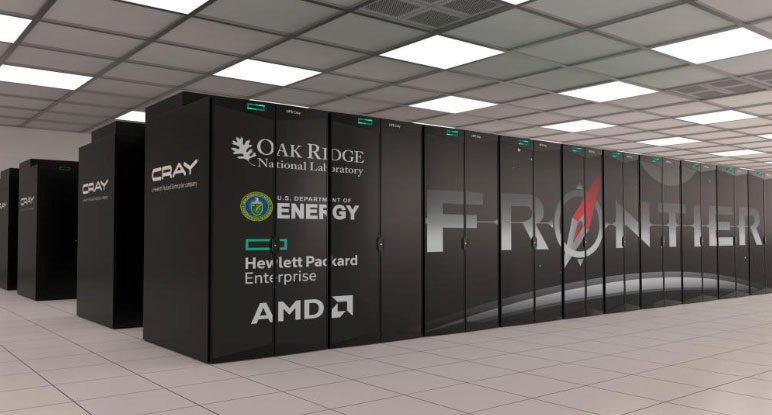
Enter Frontier, ORNL’s exascale supercomputer, which became operational in 2022 with 100 times the computing power found in typical universities, labs, or industrial environments. It can process billions upon billions of operations per second. Frontier’s processing speed is so powerful, it would take every person on Earth combined more than four years to do what the supercomputer can in one second.

“Frontier has more in common with the Hubble Space Telescope or the Large Hadron Collider (a particle accelerator) than with your laptop,” Messer emphasized.

Oak Ridge exascale supercomputer
Pictured above is the Frontier exascale supercomputer in Oak Ridge. Capable of performing two quintillion calculations per second, or two exaflops, Frontier features 74 Olympus rack HPE cabinets, each the size of a refrigerator and weighing 8,000 pounds. Each cabinet contains 128 AMD compute nodes. (Photo by ORNL)

Messer shared how GE Aerospace did one of the largest turbulence simulations ever attempted to study ways to negate the effect of turbulence on commercial flights. NASA is leveraging Frontier to understand the role of turbulence in flying and landing on Mars.

Concluding his talk, Messer invited proposals year-round from the audience to get time on the Frontier system, which is open to U.S. and most global researchers with some exceptions. He cautioned that only projects with the right level of computing complexity will benefit from exascale computing.

During the Q&A he said that his team has concluded an RFP for Discovery, the next exascale supercomputer that will replace Frontier.

When asked about exascale computing’s role in quantum computing, Messer said, “I’m a quantum advocate. My suspicion is over the next decade quantum computing will make the biggest impact on what I would call quantum problems – problems like computational chemistry, which may have an impact on things like aerospace.” He said there is a small team at ONRL looking at doing compressible hydrodynamics using quantum computing.

“I think the ability to do that on a very large scale is a way off,” he concluded.

“It was a very interesting talk,” said forum attendee Mike Ferguson, a flight test engineer at Johns Hopkins Applied Physics Lab in Maryland. “I definitely think there are problems at our lab that could use that kind of computing infrastructure, but it would take some investigating and some actual deep thinking from all of us to figure that out.”

 On Demand Recording Available

Watch Full Session On Demand 

ULA’s Vulcan Centaur Rocket Set to Launch on January 8

Gizmodo reports United Launch Alliance’s “202-foot-tall (61.6-meter) Vulcan Centaur rocket is set to launch from Space Launch Complex-41 at Cape Canaveral” on Monday, January 8. According to Gizmodo, this is a “huge deal, as it marks the debut of ULA’s first new rocket design in 18 years. While the (mostly) expendable Vulcan Centaur may not be revolutionary from a technological perspective, it represents a significant evolutionary step for ULA.”
Full Story (Gizmodo)

Dryden Lecturer Addresses Future of Getting to Greener Aviation

By Anne Wainscott-Sargent, AIAA Communications Team

As the aviation sector looks to achieve net zero carbon emissions by 2050, the biggest gains may not happen in the air but on the ground, stated Tim Lieuwen, the 2025 AIAA Dryden Lecturer in Research, during the 2025 AIAA SciTech Forum in January.

Watch Full Session On Demand 

“The least cost way to get to a net-zero society is to take a system view about economy-wide CO2 emissions and where and how aviation fits into that, rather than trying to zero out CO2 emissions sector by sector.  It makes sense if you think about it – it’s a whole lot cheaper to manage your CO2 emissions from something that’s sitting on the ground, potentially sitting right above a depleted oil reservoir versus trying to manage something that’s flying around and has to deal with all the safety issues of aviation,” said Lieuwen.

The Georgia Tech executive vice president for Research, Regents’ Professor, holder of the David S. Lewis, Jr. Chair, and the executive director of the Strategic Energy Institute  explored the interconnectedness of energy sources, carriers, and storage systems, noting the significant role of fossil fuels in the current U.S. energy system and the potential for synthetic fuels.

He highlighted four different options for zeroing out climate impacts using a high-fidelity model of the entire energy system. Organized in a 2×2 matrix, the model showed the option of economy-wide decarbonization, where different sectors contribute in a coordinated way. Then he presented a visual of sector-by-sector decarbonization, where each sector individually zeroes out its contributions.

According to the EPA, transportation is the largest contributor of CO2 emissions, with the aviation sector contributing roughly 2.5%, compared with 28% from automobiles.

Lieuwen noted there is a difference between zero CO2 and net zero. Net zero focuses on the overall CO2 emissions budget, allowing for some sectors to potentially emit CO2 and some sectors to be net-negative CO2.  In this scenario, the least-cost role of aviation in an economy wide net-zero CO2 society is a mix of conventional fossil fuels and renewable hydrocarbons like sustainable aviation fuels (SAF). If aviation’s aim is to pursue “a least-cost societal net-zero target,” then he advocated for an economy-wide net zero strategy.

Using a least-cost model, the energy expert showed some surprising insights where fossil fuels and renewable fuels are equally split 50/50.

“Half are fossil fuels and the other half are synthetic fuels that you can manufacture like SAF. You see big growth in renewables and big growth in biofuels,” he explained.

Lieuwen also observed that in this least-cost world, half of all energy will rely on electricity which will prompt big growth in electrification, going from 20% to 50%. He also predicted significant R&D investments around power electronics, high-voltage motors, batteries, and energy storage.

Fossil Fuels Dominate Current Energy Economy
Another big takeaway was how society moves and stores energy will continue to use  fossil fuels, although in a significantly diminished role from today.

“We’re in an 80/20 split with the current U.S. energy economy as a whole, which means that we use fossil fuels roughly for 80% of the means by which we move energy around and store it. We use electricity as an energy carrier for the other 20%. These are multi-trillion-dollar sectors. It’s important to recognize the interconnectedness of all this. For example, the aviation sector is leveraging and contributing technologically to and is also benefiting from infrastructure of existing industrial sectors, such as oil pipelines and the oil refining industry.”

Aviation’s Critical Role
Part of achieving this least-cost societal net-zero target in aviation is developing SAF, which currently are more expensive than fossil fuel, and will likely require policy levers, carbon taxes, or tax credits to become a reality, Lieuwen predicted.

There will continue to be a premium placed on aviation advances that offer thermal efficiency as well as operational flexibility.

“The ability to have systems that are low emission/high efficiency, but yet don’t surge/don’t stall, where your flame stays attached, where the system is stable, is very, very important,” said the researcher before briefly sharing highlights of his research that focuses on better understanding the interaction of how fast waves of flames move in combustion engines.

“The interaction of acoustic waves… create interference patterns which are controlled by how fast vortices move versus how fast waves on flames move,” he explained. “If a vortex is not moving at the same speed, what’s happening is you have two periodical disturbances moving at different velocities.”

This phenomenon leads to destructive instabilities in rockets, in home heaters, and in aircraft engines, Lieuwen shared.

Asked after his presentation if he thought the increased tempo in rocket launches would hurt efforts to decarbonize, Lieuwen said, “I would suspect the overall carbon footprint that is going to those direct launches will pale relative to other sectors.” He predicted major follow-on secondary impacts from all the satellite activity, however.

Nuclear’s Potential
Another question concerned the role of nuclear energy in getting to net zero. “Nuclear is really important,” said Lieuwen. “In fact, if we could solve this problem of low-cost nuclear [energy] it would totally transform what least-cost net zero looks like.”

Amanda Simpson, former deputy assistant Secretary for Energy under the Obama administration who also directed the U.S. Army Office of Energy Initiatives, found Lieuwen’s remarks timely and on target. The former VP for Research and Technology and head of Sustainability for Airbus Americas said that the aviation sector has grappled with the question of whether net zero by 2050 is the right commitment.

“While it’s an admirable goal, is it a realistic? It’s a very expensive and difficult goal,” she said.
Simpson added that addressing the CO2 issue in aviation is also hard, and she agreed with Lieuwen that it’s easier to decarbonize something on the ground.

“There’s so much to be done in the remaining 26 years, we have to go after everything. There is not going to be a silver bullet – we have to tackle everything to start bringing the [greenhouse gas usage] totals back,” she said.
 On Demand Recording Available

Watch Full Session On Demand 

AFRL Digital Transformation Champion Urges People to Embrace, Not Fear AI

By Anne Wainscott-Sargent, AIAA Communications Team

ORLANDO, Fla. – If Alexis Bonnell had her way, every person would embrace Artificial Intelligence (AI) fearlessly as a tool that gives them back “minutes for their mission” and enables them to “tackle the toil” of mundane work tasks.

The charismatic former Googler, now serving as chief information officer and director of Digital Capabilities Directorate for the Air Force Research Lab (AFRL), believes technology fails when it fails to serve people.

Watch Full Session On Demand 

While AI and generative AI promise to bring new efficiencies to all industries and in many instances, reinvent how work is done, it also is a transformative force that many people fear will take away their livelihoods. According to Bonnell, the way the work world packages and frames AI makes it difficult for people to accept the tool.

The visionary behind AFRL’s digital transformation doesn’t talk or act like a typical government executive. Speaking before a standing-room-only crowd at the 2025 AIAA SciTech Forum, she stood out among the room of business-dress-attired engineers and managers, wearing a red top, dark jeans and star-studded knee-high boots. She donned multiple black rubber wristbands with her favorite AI catch phrases that she gave away as keepsakes to inquisitive attendees following her talk.

Bonnell’s presentation included advice on bringing about necessary cultural change in how workers and managers view AI, using insights of what she’s learned from her team’s rollout of NIPRGPT, AFRL’s AI Research Platform to explore the power of Generative AI technology. Launched in June, NIPRGPT’s base of volunteer users grew to about 80,000 in four months, reported InsideDefense. Interest in access to AI tools across the Department of Defense shows no signs of slowing.

In a June 2024 news release announcing the tool, Bonnell noted that “changing how we interact with unstructured knowledge is not instant perfection; we each must learn to use the tools, query, and get the best results. NIPRGPT will allow Airmen and Guardians to explore and build skills and familiarity as more powerful tools become available.”

To the AIAA SciTech Forum’s technical audience, she cautioned that some of her insights may be wrong in six months and “that’s okay…. We’re in an era where we may not have the time for the right answer, so we have to become comfortable with ‘right for now,’ be willing to learn and pivot,” she said. She added that when she thinks about generative AI, she doesn’t think about it as a source of answers, but “as a source of options.”

In answering why the world is clamoring to AI tools now, Bonnell said it’s important to realize that “we now live in a fundamentally different age” – one where people in leadership roles must make decisions and adapt quickly and pivot as conditions change. Consider that 90% of the world’s data was created in the last three years, with 94% of it what Bonnell called unstructured “deluges.”

A sign of the changing times is also evident in battlefield decision-making trends. In the war between Russia and Ukraine, Bonnell said the time frame for Russia countering Ukraine’s software has shrunk, in some cases, to only two weeks. That kind of speed requires new information tools and the ability to make decisions fast. As a result, “we have to think about our technology differently than we did before.”

Bonnell dislikes the mixed messages people have historically received about AI: “We tell people we trust you with a weapon, with a $100M budget, with a security clearance and lots of sensitive information, but we don’t trust you with ChatGPT. What are we actually telling people?” she questioned. “It’s important that we make people feel like they are enough, that they’ve got this, that they are capable, and that we trust them to use tools in the right way. Our future as humans is constant adaptation, the only group that benefits when we are afraid of our own technology is the adversary.”

The technologist noted that the world is not communicating the value of AI in the right way; instead, the first thing people hear is that it’s really complicated, technical, and hard. “That kind of tells someone, ‘You’re not smart enough.’”

She urged a change in the AI narrative and a recognition that as public servants and military personnel, they are showing up to their jobs to be intentional and responsible.

The AFRL leader emphasized the main job of AI in its first phase of human adoption is to simplify and shave off time of mundane work, so people can gain back “minutes for their mission.” That’s exactly what the coders and developers on the AI Research Platform have realized: they report that they have gotten between 25–85% in productivity return using AI tools, Bonnell said.

Bonnell noted that AI and genAI are fundamentally different than other technologies because of the level of intimacy of knowledge that the tools deliver.

“Users get to collect information and the data that they think is relevant and then they use the tool to have a curiosity-based relationship with that data.”

Bonnell has observed at AFRL that her team is leveraging genAI to create a “knowledge universe” around themselves without needing to ask her for information, a discovery that has prompted her to rethink her role as a leader. She challenged other people in CIO roles to be similarly introspective: “For those of in roles like CIOs, it’s a question of how are we going to show up? Are we going to be a gatekeeper or are we going to be a facilitator? There’s a lot of interesting things this is putting into motion.”

In her case, Bonnell is looking at how she can get out of the way of this curiosity journey. “How do I foster the ability for someone to need me less and be able to have a dynamic relationship with knowledge?”

After the presentation, several attendees expressed their appreciation for Bonnell’s take on the state of AI attitudes, workplace culture, and the need to lead differently.

“I like how she talked about coming from the direction ‘see what we can do here’ instead of from a caution perspective of ‘I don’t know if we can do that’ to an attitude of ‘let’s figure out how we can make this work,’” said Christine Edwards, a fellow of AI and Autonomy at Lockheed Martin, whose work includes providing cognitive assistance for firefighters and looking at how to use AI to improve spacecraft operations.

Edwards also enjoyed Bonnell’s insights about trust and AI. “She said it’s less about whether I trust this new technology and more about ‘do I have the confidence that it’s going to have the performance I need for this particular part of my mission?’ I really like that perspective shift.”

John Reed, chief rocket scientist at United Launch Alliance, said he appreciated that Bonnell provided tools for mitigating some of the fear the workforce has about AI. “That’s helpful to think through the stages and the fact that there are going to be people who are concerned, ‘Is this going to eat my job?’  It’s really an augmentation technology just like machine learning. It’s best employed when it’s done to augment the algorithms we’re doing today to make it more effective,” he explained.

The talk also resonated deeply with Marshall Lee, senior director of business development at Studio SE Ltd., a consulting firm focused on model-based systems engineering (MBSE) training and coaching.

“Us engineers are all about the tool, the technology, the formula, the detail. She’s really addressing the changes in brain chemistry and emotion [necessary] for the adoption of the technology,” said Lee. “She’s actually saying you have to change the psychology of the person first before they are going to adopt the new technology. It’s all about that emotion and behavior change and understanding people, starting with where they are.”

 On Demand Recording Available

Watch On Demand