Kloby’s Smokehouse, Laurel, MD
Open to all attendees!

Dr. King believed in the opportunity to provide service. He said, “Everybody can be great … because anybody can serve.” These panelists exemplify King’s call to service. Join the conversation with three Black female panelists who will share their dreams, discuss their service, and look ahead toward their next feats. This industry panel discussion will be moderated by Enanga Daisy Fale, Executive Director of the NSBE Aerospace SIG and the newly appointed Regional Deputy Director of Membership within AIAA. Attendees will be invited to interact with the panel and submit questions.
Register for the full MLK Day: A Tribute to Service program
Click on the panelist profiles below to watch their promotional videos.
Come unwind and network with other young professionals who are also attending the forum.
Exclusive event to hear distinguished panelists discuss their leadership and innovation journeys. The dialogue will explore how leadership, innovation, and intersectionality combine to shape leaders and the workforce of today and tomorrow. Join us for an evening of networking and inspiring conversation.
Powered by AIAA, ASCEND is building a fast-growing community that propels the global conversation about space commerce, exploration, and new discovery. Before ASCEND launches its main programming in November 2021, get a taste of the type of cross-cutting content that is part of this event. Join ASCEND Executive Producer, Rob Meyerson, for a special play-back of an ASCENDxSeries session “New Opportunities in Fusion for Space Power and Propulsion” that was put on in partnership with the Fusion Industry Association. Speakers featured in this session include Julie Reiss (The Aerospace Corporation), Stephanie Thomas (Princeton Satellite Systems), Setthivoine You (Helicity Space), Doug Witherspoon (NearStar Fusion), and David Kingham (Tokamak Energy).
High-speed vehicles are subject to complex fluid effects including shocks, turbulence, real gas effects such as dissociation and nonequilibrium energy distributions, high-temperature gas-surface reactions, and combustion. Due to these complexities, detailed experimental measurements are necessary for the successful design and optimization of supersonic and hypersonic vehicles. However, most of these phenomena are difficult or impossible to study using surface measurements due to their limited domain or physical probe-based techniques that inherently perturb the environment they aim to study. In contrast, optical and spectroscopy-based techniques offer the ability to make off-body measurements with little-to-no system perturbation of qualitative and quantitative flow properties including velocity, gas temperature, and species densities. This course aims to provide background theory on several spectroscopy techniques, technology required to execute measurements, and examples how they have been implemented previously for large scale wind tunnel testing.
Who Should Attend: Practicing engineers and graduate students involved with experimental hypersonic research. Program managers and technical area leaders responsible for future Hypersonics development.
Instructors (tentative):
Dr. Chloe Dedic received her B.S. and Ph.D. degrees from Iowa State University in 2012 and 2017, respectively. After graduation she worked as a visiting scientist with the National Institute of Aerospace at NASA Langley Research Center and joined the University of Virginia as an assistant professor in 2018. Dedic is an active member of the American Institute of Aeronautics and Astronautics (AIAA) and serves on the AIAA Technical Committee on Aerodynamic Measurement Technology. She is also currently serving as the UVA MAE Director for Diversity, Equity, and Inclusion. Professor Dedic’s research interests are centered around the development and application of advanced laser-based diagnostics and nonlinear spectroscopy techniques to study nonequilibrium, reacting, and multiphase flow environments with the goal of furthering the development of technologies related to clean energy and hypersonic propulsion and aerodynamics. In particular, Dedic is interested in applying complex laser measurements to study harsh environments while emphasizing measurement accuracy and spatial and temporal resolution. Her expertise includes the development of advanced laser diagnostics—in particular femtosecond/picosecond coherent anti-Stokes Raman scattering (fs/ps CARS)—and deployment in challenging flows characterized by extreme pressures, shock waves, large temperature gradients, transient flow dynamics, and nonthermal energy distributions. Applications include nonequilibrium flows, supersonic combustion, atmospheric entry, detonations, and renewable energy.
Dr. Christopher Goyne, Associate Professor, Director of the UVA Aerospace Research Laboratory. Professor Goyne obtained a Bachelor of Mechanical Engineering and Ph.D. from the University of Queensland, Australia. During his Ph.D. research, Goyne specialized in high-speed aerodynamics, high-speed air-breathing propulsion and instrumentation development. Upon completion of his graduate studies, Goyne joined the Department of Mechanical and Aerospace Engineering at the University of Virginia as a Research Associate. Here he conducted research in hypersonic propulsion using the University of Virginia’s unique Supersonic Combustion Facility. This work was funded by NASA’s Hyper-X Program. He briefly returned to the University of Queensland to participate in the HyShot scramjet flight test program before joining the faculty at the University of Virginia. Now an Associate Professor and Director of the Aerospace Research Laboratory, he continues his work in hypersonic air-breathing propulsion, supersonic aerodynamics, hypersonic ground and flight test techniques, diagnostic and measurement technique development, controls and advanced manufacturing. Goyne also conducts research on the interaction of fluids with rotating machinery in collaboration with the Rotating Machinery and Controls (ROMAC) Industrial Program at the University of Virginia. Goyne is an Associate Fellow of the American Institute of Aeronautics and Astronautics and past Chair of the Hypersonic Technology and Aerospace Planes Program Committee. He is also a member of the American Society of Mechanical Engineers. He currently serves as an Associate Editor for the Shock Waves journal. Goyne has lead roles within the University Consortium for Applied Hypersonics. As part of this organization, he is the International Teaming lead on the Research Engagement Committee and is the Technical Area Collaboration Co-Lead for air-breathing propulsion. Goyne also serves on the Governor of Virginia’s Aerospace Advisory Council and is Chair of the Virginia Space Grant Consortium Advisory Council.
Dr. Robert P. Lucht, Ralph and Bettye Bailey Distinguished Professor of Mechanical Engineering, and Director of Maurice J. Zucrow Laboratories, School of Mechanical Engineering, Purdue University Research: Laser diagnostics, Diode-laser-based sensors, Gas turbine and internal engine combustion, Materials processing and synthesis, Combustion science, Fluid mechanics and heat transfer
Dr. Christopher S. Goldenstein, Assistant Professor of Mechanical Engineering, School of Mechanical Engineering, Purdue University. Fundamental Research Area(s): Thermodynamics, Fluid Mechanics Systems, Measurements & Controls. Research: Laser-absorption spectroscopy, laser-induced fluorescence, & IR imaging sensors for gas temperature, pressure, velocity, and chemical species
Molecular spectroscopy, photophysics, & energy transfer in gases, Energetic materials (e.g., explosives & propellants) detection & combustion, Combustion and propulsion systems (small and large scale), Biomedical sensing.
Dr. Terrence R. Meyer, Professor of Mechanical Engineering; Professor of Aeronautics and Astronautics (by Courtesy), School of Mechanical Engineering, Purdue University. Research Interests: Laser spectroscopy and imaging for combustion, sprays, energetics, hypersonics, plasmas, and non-equilibrium flows; Applications to gas-turbine, rocket, internal combustion, and scramjet engine performance, efficiency, and emissions; Thermal-fluid behavior at the extremes, including turbulent, high-temperature, high-pressure, multiphase, and non-equilibrium reacting flows
Mikhail Slipchenko, Research Associate Professor, School of Mechanical Engineering, Purdue University
 Watch the second episode in the documentary series, “Red Tail Angels – The Story & Legacy of the Tuskegee Airmen.” This series showcases the hardships, struggles and ultimately the successes of the Tuskegee Airmen, the first Black men given the opportunity to serve as military aviators in the U.S. Army Air Corps that became the U.S. Air Force.
The film will be hosted by Joi C. Spraggins, PhD, founder of Legacy Bridges, a NASA-Related Career and Technical STEM Education, Workplace and Workforce Development Innovation Center. Dr. Spraggins also is an AIAA Member.
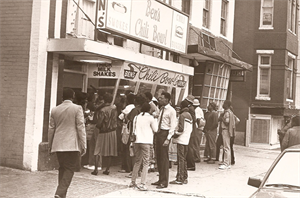 Ben’s Chili Bowl has been a mainstay of the Black community in Washington, D.C., for nearly 62 years. It stands as a historic example of how a business can serve as a driver of economic development during good times and provide hope and solidarity to a community during hard times.
Virginia Ali, cofounder of Ben’s Chili Bowl with her late husband, Ben, will share stories about sitting with Dr. King and later with the first Black President of the United States, Barack Obama, and share how her restaurant has served as a gathering place for everyone, whether you are homeless or the President of the United States.
Ben’s current staff will share a cooking demonstration of some of their specialties.